Safety Tips for Train and Bus Travel
Why safety feels different on trains and buses
Every travel mode brings its own brand of stress. In cars, it’s the constant vigilance against accidents. On planes, it’s turbulence and security checkpoints. On trains and buses, the vehicle itself is rarely the issue. The real challenge is the environment: crowded stations, narrow aisles, and the logistics of keeping track of both kids and belongings.
That doesn’t make them unsafe. In fact, statistically trains and buses are among the safest ways to travel. But families need to think less about “what if” accidents and more about the everyday challenges that make parents sweat. With some planning and clear routines, most of those stress points can be smoothed out.
What you’ll find in this guide:
Navigating stations and terminals
Boarding and disembarking
Keeping track of kids on board
Luggage, strollers, and valuables
Managing bathrooms and other needs
Overnight journeys: safety while you sleep
Handling uncomfortable situations
Spotting and avoiding common scams
Teaching kids their own safety basics
Safe, not stressful
FAQ’s
Navigating stations and terminals with kids
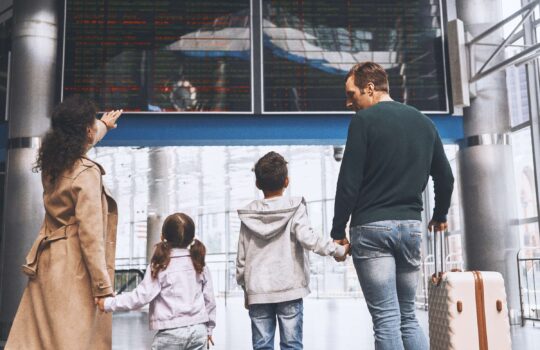
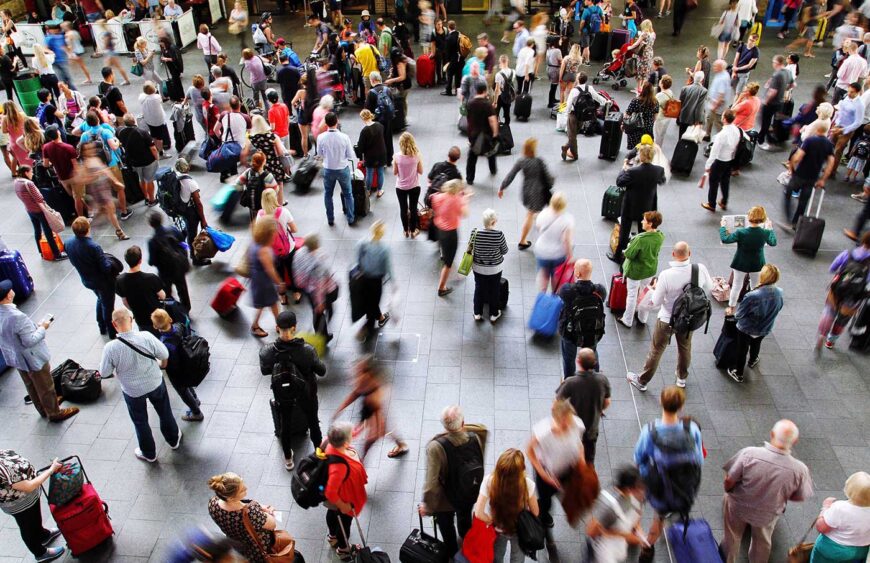
For many parents, the most stressful part of a train or bus journey isn’t the ride itself, it’s getting through the station. Terminals are noisy, crowded, and filled with distractions. Kids see wide-open spaces as playgrounds, while parents are juggling tickets, luggage, and strollers. It only takes one second of distraction for a child to dart ahead.
Bus stations can feel especially chaotic. Signs are unclear, schedules are inconsistent, and you’re never entirely sure which bay your coach will arrive at. Add in a crying toddler or a heavy bag, and the pressure spikes. Parents who’ve been there describe it as “herding cats in a shopping mall.”
That’s why experienced families approach stations with as much strategy as the actual journey.
A few small habits help turn chaos into something manageable:
- Plan your route before you arrive. Know which platform, gate, or bay you’re heading for. Stopping in the middle of a busy station to squint at signs is when kids wander and parents lose track of bags.
- Use carriers for little ones in crowded concourses. A stroller is great once you’re rolling, but escalators, stairs, and narrow platforms make them awkward at peak times.
- Stick to the edges, not the middle. Families move more safely when they’re out of the thick of the crowd, where it’s easier to hold hands and keep pace.
Boarding and disembarking without chaos
Getting on and off a train or bus is often the most nerve-wracking moment of the trip. Suddenly everyone is moving at once: passengers rushing doors, drivers hustling luggage, kids tugging your arm while you’re trying not to drop a bag.
Parents often underestimate how stressful those two minutes can be. Kids are excited and distracted, and it only takes one stumble or one misplaced bag to make boarding feel like a fiasco.
These small adjustments help:
- Hold hands at the doors. The small gap between platform and train, or between curb and bus step, is just enough to trip little feet. Keep everyone physically connected until you’re settled inside.
- Time your boarding. Boarding early means you secure overhead space and settle in calmly. Boarding late means less waiting time for restless kids. Decide what works best for your family dynamic.
- Divide and conquer. One parent boards with the luggage while the other stays back with kids, then swap. Trying to move everyone in one push is usually where mistakes happen.
Keeping track of kids on board
Once you’re seated, the safety focus shifts from boarding chaos to containment. On trains, kids have more freedom to stretch and explore. On buses, that freedom disappears. Movement is limited, and the aisles aren’t safe places to roam. Parents need to adapt their approach depending on the mode of travel.
What works well is to establish routines early. Before the trip, explain the “train rules” or “bus rules” in simple terms: stay with your seat, no running, always check with Mom or Dad before moving. Kids love having clear roles, and it makes the environment less unpredictable.
Practical seating strategies help too:
- Add an ID bracelet or tag. A simple wristband with your phone number gives peace of mind in case of separation, especially at stations.
- Book family blocks of seats. On trains, tables are gold. Everyone faces each other, and kids stay in one contained zone. On buses, the middle rows are safest (away from the bathroom bustle and rowdy back seats).
- Set boundaries for movement. Kids can walk to the café car or bathroom, but only with a parent. Younger children stay seated unless escorted.
Luggage, strollers, and valuables
Unlike in a car, where everything is within reach, trains and buses put your belongings in vulnerable places. On trains, big bags often live at the carriage ends, out of sight. On buses, luggage goes underneath, completely inaccessible until you arrive. Parents can feel torn between watching their kids and keeping an eye on their bags.
The trick is preparation, not paranoia. Most thefts are crimes of opportunity and easily avoided.
Parents who’ve done this dozens of times swear by a few simple rules:
- Have a stroller strategy. On buses, prams usually go under the coach, which means you’ll want a baby carrier on hand. On trains, foldable strollers fit better in racks than full-size ones.
- Use small locks or luggage straps on bags stored away from your seat. They won’t stop a determined thief, but they prevent “grab and go” theft.
- Pack a seat-side survival kit. Snacks, wipes, entertainment, meds, and one spare outfit for each child should stay with you. If your main luggage disappears into the hold, you’ll still survive the journey.
Managing bathrooms and mid-journey needs
The one guarantee of family travel is that someone will need the bathroom at the worst possible time. On buses, that’s a particular challenge. Toilets exist, but they’re small, bumpy, and not toddler-friendly. Parents joke that they’d rather hold out for a roadside stop than attempt a diaper change in a moving coach.
Trains are better, but not perfect. The facilities are larger, but still cramped, and they get messy quickly on busy routes. The key is to expect the worst and pack accordingly. Parents who prepare a “bathroom kit” rarely regret it.
Smart packing includes:
- Plan bathroom runs. Don’t wait until “I need to go right now.” Pre-emptively take kids when the train is steady or at station stops.
- Wipes and sanitizer. Surfaces are rarely as clean as you’d like.
- Spare outfits. One small accident can otherwise derail the trip.
Overnight journeys: safety while you sleep
Traveling at night can feel like an adventure for kids because of bunks on trains, or the reclining seats on buses. But for parents, the question is always: how do I keep everyone safe while we sleep?
On trains, compartments feel private but aren’t always secure. Locking the door, when possible, is a must. Many parents tuck valuables into pillowcases or keep them in a money belt. On buses, safety comes from seating choice. Families often feel better closer to the driver or near other families.
The goal is to reduce how much you worry once the lights go out:
- Set out essentials early. Water, wipes, blankets. All within reach, so you’re not fumbling in the dark.
- Secure the door or seats. If it locks, use it. If not, position bags in a way that blocks easy entry.
- Keep valuables close. Phones, passports, and wallets should stay on your body, not in overhead racks.
Overnight trips can be wonderful memories if handled well. In Overnight Trains with Kids we go deeper into planning cabins, packing, and setting routines that let everyone rest.
Handling strangers and uncomfortable situations
Most passengers are either helpful or minding their own business, but occasionally you’ll get seatmates who cross boundaries. Maybe they overshare, maybe they offer your child candy, maybe they just make you uncomfortable.
Parents sometimes feel guilty about moving or saying no, but you shouldn’t. Your comfort (and your child’s) comes first. On trains, simply changing carriages is usually an option. On buses, speaking to the driver or staff is the best move.
Teaching kids polite boundaries helps too. A firm “no thank you” when offered something by a stranger is both safe and empowering. The key message is that if something feels off, you trust your instincts and act on them.
Spotting and avoiding common scams in stations
Large European stations like Paris Gare du Nord, Rome Termini, Barcelona Sants are safe in terms of violence, but they’re hotspots for petty scams. Families with kids and luggage look distracted, and that’s exactly what scammers target.
The scams are rarely dangerous, but they’re stressful. Knowing what to expect takes away their power.
Common ones include:
- Petition scam: Someone pushes a clipboard at you, asking for a signature, while an accomplice eyes your bag.
- Friendship bracelet scam: A person ties a bracelet onto your wrist or your child’s, then demands payment.
- Distraction team-ups: One “drops” something or asks for help while another reaches into your bag.
- Fake helpers: People offer to guide you, buy your ticket, or “help” with luggage and then demand cash or lead you away from official counters.
Where you’ll see them most: station entrances, ticket machines, and busy tourist platforms.
How to deal with it: be polite but firm. A quick “no” or even ignoring works best. Keep valuables zipped inside a crossbody bag. Teach kids not to accept gifts from strangers. And always buy tickets from official counters or machines. Once you know the patterns, these scams are easy to sidestep.
Teaching kids their own safety basics
Parents can’t do everything. Teaching kids simple safety rules gives them ownership too. And kids usually love the responsibility.
The basics:
- Stay close in stations. No wandering, even if the kiosk looks tempting.
- Know your info. For younger ones, a bracelet with your phone number works. Older kids should know your name and the station you’re heading to.
- What to do if separated. Teach them to look for staff in uniform, not random strangers. Practicing this at home with role-play makes it less scary if it ever happens.
Many families even give kids “jobs”: one watches the stroller, one presses the elevator button, one counts the bags. Turning safety into responsibility helps kids feel involved instead of managed.
Safe, not stressful
Trains and buses are, by almost every measure, safe ways to travel. The real challenge isn’t accidents, it’s the chaos of stations, the limits of long rides, and the unpredictability of strangers or scams.
Parents who travel this way often say the same thing: once you know what to expect, it gets easier every time. A little preparation, some clear family rules, and a dose of common sense turn potential headaches into nothing more than background noise.
Safety isn’t about being paranoid. It’s about having confidence. When parents feel prepared, kids pick up on that calm, and the whole trip becomes smoother.
Too Long? Here are the most common questions we’re asked.
Yes. Statistically they’re very safe. The main risks are crowded stations, restless kids, and petty scams, not accidents.
Use carriers for toddlers, stick near walls instead of the center of crowds, and plan your route before arriving.
Lock or strap bags stored on racks, and keep a “within reach” bag with essentials by your seat.
Avoid petitions, bracelets, and “helpers.” Buy tickets only from official machines or counters.
On trains, lock your cabin and keep valuables close. On buses, sit near the driver and pack essentials within reach.