Why families choose overnight trains
For parents, distance is often the toughest part of travel. Long car journeys turn into endless bathroom breaks, flights drain both energy and money, and buses test patience with every extra hour. Overnight trains flip that problem on its head. Instead of spending the day dragging children across highways or through airports, you tuck them into bed, let the train do the work, and wake up in a completely different city.
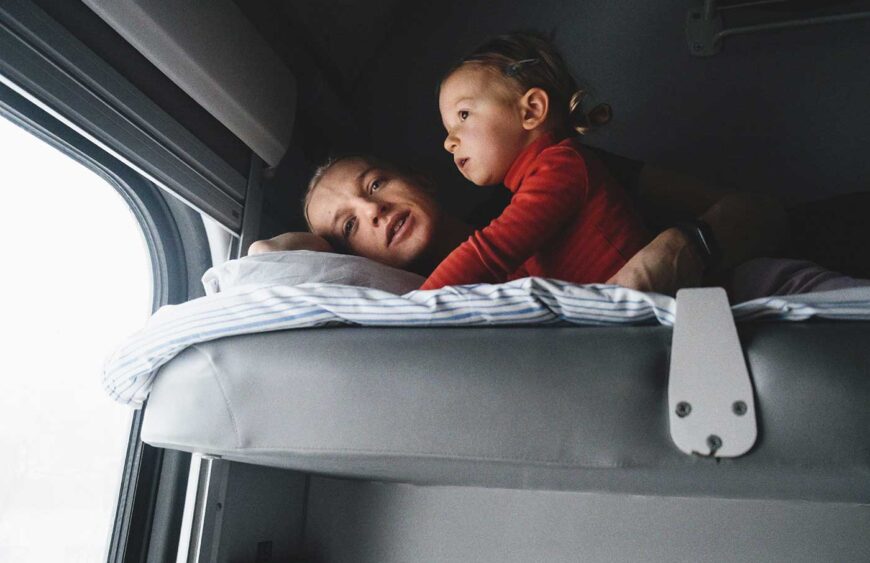
The appeal is clear. Night trains cut costs by replacing a hotel stay, maximize the time you can spend exploring your destination, and create memories in the process. Kids are usually fascinated by the idea of sleeping on a moving train. They love bunk beds, they giggle at brushing teeth while the carriage sways, and they tell stories later about how they “went to bed in one country and woke up in another.” For parents, it’s both practical and magical. A rare combination in family travel.
What you’ll find in this guide:
Booking the right type of sleeper
Setting up kids for sleep success
Packing essentials for overnight journeys
Food, snacks, and midnight hunger
Safety tips while you sleep
Best overnight train routes in Europe
Morning routines and arriving refreshed
When overnight trains aren’t the best choice
Turning travel into an adventure
FAQ’s
Booking the right type of sleeper
The comfort of your journey depends heavily on the sleeper you choose. Families who grab the cheapest option often regret it when they find themselves in a shared couchette, trying to keep their toddler quiet while strangers climb in and out. Couchettes are basic shared compartments with four to six bunks. They’re fine for older kids, but they’re a stressful gamble for parents of younger ones.
Private family cabins, on the other hand, offer a compact but self-contained space with two to four bunks and sometimes a small sink or bathroom. They cost more, but they buy you freedom: the freedom to keep your own routine, handle noise without guilt, and let kids be themselves. Many parents who have made the switch say the difference in price is worth every cent. Luxury sleepers, with hotel-style comfort and private bathrooms, are the most indulgent option, but they’re usually impractical for everyday family trips. Whatever you choose, book early. Family cabins are in short supply and tend to sell out quickly, especially in summer.
Setting up kids for sleep success
It’s tempting to imagine that the rocking of the train will lull kids into peaceful sleep. Sometimes it does, but more often the novelty of bunks, the rattling of wheels, and the thrill of being in a new environment keep children awake longer than expected. Parents who manage best tend to recreate their at-home routines on the road.
Brushing teeth at the same time, reading a bedtime story, or letting children cuddle their usual blanket or stuffed toy helps them feel grounded in the familiar. Noise and motion can be masked with a white noise app or a favorite playlist, while a small nightlight softens the extremes of cabins that are either too dark or too bright. Even small details, like slipping a pillowcase from home over the provided pillow, can help children relax and fall asleep faster. Consistency is what signals their bodies that bedtime has truly arrived.
Packing essentials for overnight journeys
Packing for a night train isn’t just about what goes in your suitcase, it’s about what you can reach once the doors close. The space is compact, and digging through a big bag at midnight is the fastest way to wake everyone up. Parents who’ve done this before often carry a small “night bag” that holds everything needed between boarding and arrival.
Inside goes the bedtime basics: pajamas, slippers, toothbrushes, wipes, tissues, and sanitizer. Layers are equally important, since cabins swing from stuffy to chilly. A hoodie or cardigan can be the difference between a comfortable night and one where nobody settles. Finally, a little wind-down entertainment. A coloring pad, a quiet audiobook, or a travel-sized game helps bridge the gap between excitement and sleep. The difference between a chaotic evening and a smooth one is simply having the right items at arm’s reach.
Food, snacks, and midnight hunger
If you’ve traveled with kids before, you know hunger never runs on schedule. On night trains, it tends to hit right after the café closes or just as children are finally in bed. Some routes have dining cars, others only a vending machine that may or may not work, and many offer nothing at all. Families who come unprepared often regret it.
Bringing your own food solves the problem. Evening snacks like fruit, sandwiches, or cheese sticks help kids settle without the sugar rush that cookies or candy would cause. Breakfast supplies are equally useful, since arriving in a new city with hungry children usually leads straight to meltdowns. A simple croissant, cereal bar, or juice box can smooth the transition into the day. Refillable water bottles are essential too, saving money and making sure no one wakes up cranky from dehydration. Parents who pack for these moments find that food is not just fuel, it’s a tool for keeping the journey calm.
Safety tips while you sleep
Even though trains are statistically safe, parents often find their nerves spike once the lights go out. You’re asleep, your kids are asleep, and the environment feels less controlled. The truth is, most risks are easily managed with a few simple steps.
Locking the cabin door makes a huge difference, and most private sleepers allow it. Keeping passports, phones, and wallets close like under a pillow or in a small pouch removes the worry of theft. Setting clear ground rules with children helps too: no opening the door during the night, and if they need the bathroom, they wake a parent first. Some parents even place their bags in front of the door or under bunks so they’re harder to move quietly. None of this is about paranoia; it’s about creating peace of mind so that you can actually rest.
We expand on broader routines in Safety Tips for Train and Bus Travel, but the heart of it is simple: a few quick habits make the night far less stressful.
Best overnight train routes in Europe for families
The revival of night trains across Europe is one of the most exciting changes in modern travel, and families are among the biggest beneficiaries. For years, many routes were being phased out, but now governments and rail companies are reinvesting. For parents, that means more opportunities to turn a necessary transfer into an adventure kids will talk about for years.
The Vienna to Venice Nightjet is one of the most beloved options, taking you across the Alps while you sleep and dropping you into gondola country by morning. Paris to Nice remains a French classic, turning a long highway drive into a sunrise on the Riviera. Berlin to Zurich connects cultural hubs with Alpine scenery, while Stockholm to Hamburg combines ferries and bridges that double as a geography lesson. Amsterdam to Vienna or Munich is a popular choice for families trying overnight trains for the first time, thanks to good cabins and manageable departure times. And soon, Zurich to Rome will join the network, offering the rare chance to fall asleep with Alpine views and wake up in the Eternal City.
More routes are coming, including Brussels to Berlin and Paris to Barcelona. The momentum is clear: Europe sees overnight trains as a sustainable, family-friendly alternative to short flights. For families, that means more choice and more chances to weave adventure into the journey itself. We’ll be covering these in more depth in Europe’s Night-Trains with Kids.
Morning routines and arriving refreshed
The final hours of a night train can feel like either triumph or chaos, depending on how the morning is handled. Kids don’t wake up cheerful by default, especially in unfamiliar places, and rushing them out the door ten minutes before arrival is a recipe for disaster.
Parents who master mornings on trains take it slow. They wake children gently and leave enough time to freshen up with toothbrushes, wipes, or a quick change of clothes. A small breakfast before arrival keeps moods even and avoids the scramble of finding food in a busy station. Perhaps most importantly, they pack up the night before. Having bags ready turns the last moments into a calm wind-down rather than a frantic scramble. Done right, the morning becomes part of the adventure. Pulling back the blinds, seeing a new city roll into view, and stepping off the train ready to explore.
When overnight trains aren’t the best choice
As magical as they are, overnight trains aren’t perfect for every family. Babies who wake every two hours rarely let parents rest, and the cramped cabins don’t make feeding or soothing any easier. Toddlers often see bunks as climbing gyms rather than beds, which can make bedtime a struggle. Shared compartments with strangers are stressful if you’re constantly worried about noise, and short routes around five or six hours often don’t allow enough real rest to justify the effort.
In these cases, alternatives might make more sense. Day trains, budget flights, or even overnight buses Family Bus Travel: Affordable or a Hassle? may be the smarter option depending on your circumstances. Knowing when not to choose a night train is just as valuable as knowing when to book one.
Turning travel into an adventure
At their best, overnight trains take the hardest part of travel distance, and turn it into the highlight of the trip. They are not flawless. Cabins are small, noise happens, and hunger doesn’t respect schedules. But with preparation, the challenges fade into the background, and what remains are the moments that stick: kids laughing in bunks, the rhythm of the tracks lulling them to sleep, the thrill of pulling into a new city as the sun comes up.
Too Long? Here are the most common questions we’re asked.
Yes. With precautions like locking doors and keeping valuables close, they’re safe and family-friendly.
Private family cabins are the top choice, offering privacy and flexibility. Couchettes are cheaper but less ideal for toddlers.
Some do, but many don’t after dinner. Always pack snacks and a light breakfast.
A small “night bag” with pajamas, toiletries, layers, snacks, and familiar comfort items.
Vienna–Venice, Paris–Nice, Berlin–Zurich, Stockholm–Hamburg, Amsterdam–Vienna/Munich, and Zurich–Rome.