Managing Parental Stress While Traveling
Lesson one in parenting, you'll never be perfect
Look, we need to talk about something nobody warns you about when you book that exciting family vacation: the stress. Not the kids’ stress (though that’s real too), but yours. That feeling when you’re juggling boarding passes, sippy cups, a melting-down toddler, and wondering why you didn’t just stay home where at least you know where the snacks are.
Here’s the thing about managing parental stress while traveling: it’s not about being a perfect parent or having everything go exactly to plan. It’s about having a few solid strategies in your back pocket for when things inevitably go sideways. Because they will. Your toddler will refuse to wear shoes in the airport. Your seven-year-old will announce they need the bathroom the second you’re strapped into your seat. And that carefully packed diaper bag? It’s somehow missing the one thing you actually need.
But you know what? Families who travel regularly will tell you it gets easier. Not because kids suddenly become tiny adults who never complain, but because you learn what actually works. You develop your own managing parental stress tips and tricks that keep everyone (including you) relatively sane. And that’s what we’re diving into today.
Whether you’re dealing with travel anxiety with kids, feeling the mental load of traveling with children, or just trying to figure out how to stay calm traveling with kids when everything feels chaotic, these strategies can help. They’re not magic fixes, and they won’t prevent every meltdown (yours or theirs). But they will make your trips more manageable and maybe even enjoyable again.
Planning That Prevents Panic
Right, so let’s start with the unglamorous truth about family travel stress management: it mostly happens before you even leave the house. The parents who seem calm at the airport? They’re not superhuman. They just did the boring prep work. Or they threatened their kids in the taxi ride over. Let’s assume they prepped though.
First lesson in not having to threaten your kids is to prebook everything you possibly can. Hotels, obviously. But also rental cars, airport transfers, and if you’re going somewhere touristy, book those attraction tickets ahead of time. Every single thing you book in advance is one less decision you have to make while simultaneously preventing your toddler from licking the hotel lobby floor. Decision fatigue is real, and it’s one of the biggest contributors to coping with travel stress as a parent. And not to upsell you on anything but in our country guides we also give you great suggestions for things you can book in advance.
Next, and this feels counterintuitive, pack less stuff. I know, I know. What if you need that backup outfit for the backup outfit? Here’s what actually happens: you end up lugging around a suitcase that weighs more than your five-year-old, and by day two, everyone’s wearing the same three outfits anyway. Pack half of what you think you need. If you forget something crucial, you can buy it. Yes, even abroad. Other countries have shops.
Build in buffer time for literally everything. Kids ruin everything. Your schedule is one of those things. The airport check-in? Add an hour. The museum visit? Add time for a meltdown and an emergency bathroom trip (because your child will suddenly need to go the moment you’re furthest from the toilets). This extra time is not about you making places on schedule, it’s your stress buffer. It’s the difference between sprinting through the terminal with a screaming child and arriving at your gate with time to breathe.
One thing that really helps with managing parental stress while traveling is giving your kids a preview of what’s coming. Show them photos of where you’re staying. Talk about the airplane or train ride. Walk through what airport security looks like. Kids handle new situations better when they know what to expect, which means less stress for them and less stress bouncing back onto you. Look up some simple travel videos together if that helps paint the picture.
And about those expectations? Lower them. Seriously. You’re not going to see twelve museums, eat at all the local restaurants, and have everyone smiling in perfectly posed photos. You might see three museums, eat at one local place and two pizza joints, and get one decent photo where nobody’s crying or making faces. That’s not failure. That’s successful family travel.
Breathing Techniques That Work
Here’s something nobody tells you about stressed parents traveling with children: your kids can tell when you’re freaking out. Even if you think you’re hiding it, they pick up on that tight-jaw, holding-your-breath energy. And then they start to freak out too. Fun times.
Deep breathing isn’t just some wellness-guru nonsense. It actually works because it tells your body to calm down on a physical level. When you’re stressed, you take quick, shallow breaths. When you deliberately breathe slowly and deeply, your nervous system gets the message that maybe things aren’t actually life-threatening after all.
Try this: breathe in for four counts, hold for two, breathe out for six. That’s it. You can do this while standing in the security line, sitting on a delayed flight, or hiding in a bathroom stall because you just need thirty seconds of peace. The six-count exhale is key because longer exhales activate your calm-down system more effectively.
Even better? Do it with your kids. Make it a game. “Let’s blow out birthday candles” or “Let’s see who can blow up an invisible balloon the slowest.” When you breathe together, you’re not just calming yourself down. You’re calming them down too, and you’re teaching them a tool they can use for the rest of their lives. Plus, it gives you something to do that isn’t checking your watch every thirty seconds.
The thing about managing parental stress tips and tricks is that the simple ones often work best. You don’t need an app or special training. You just need to remember to breathe before you snap at everyone in a ten-foot radius. Which, let’s be honest, we’ve all been close to doing.
The 5-4-3-2-1 Trick for When Everything Feels Overwhelming
Sometimes when you’re dealing with parent overwhelm on family trips, your brain just spins. You’re thinking about the connecting flight, whether you packed enough snacks, that weird noise your kid’s making, if you locked the front door, and also why is everyone looking at you? That mental spiral doesn’t help anyone.
Enter the 5-4-3-2-1 grounding technique. It sounds a bit new-agey, but it’s actually just a way to get your brain to stop spiraling and focus on what’s actually happening right now. And right now, you’re probably fine. Stressed, yes. But fine.
Here’s how it works: Find five things you can see. A red suitcase. A coffee shop sign. Your kid’s dinosaur backpack. A woman in a yellow jacket. The gate number. Just look around and notice five things. Then find four things you can touch. The armrest. Your phone. Your child’s hand. Your water bottle. Three things you can hear. Announcements over the PA. People talking. Rolling suitcases. Airplane engines. Two things you can smell. Coffee. Someone’s perfume. Or maybe just airport smell, which is its own thing. And one thing you can taste. That old piece of gum. The coffee you’re drinking. Your own morning breath.
What you’ve just done is pulled yourself out of that mental spiral and back into the present moment. You’re not thinking about the seventeen things that might go wrong. You’re here, now, and you’re handling it. Kids can do this too, by the way. Turn it into a game. “Let’s find five things that are blue!” It keeps them occupied and helps manage their anxiety at the same time.
This is one of those travel stress tips for parents that works whether you’re in an airport, on a crowded train, or in the middle of a foreign city trying to figure out which way is north. It takes maybe two minutes, and it can completely shift how you’re feeling.
Smart Packing for Stressed Parents
Let’s talk about what actually needs to go in your bag, because half of coping with travel stress as a parent is being prepared for the chaos without turning into a pack mule.
Snacks. This isn’t optional. This is survival equipment. Pack more snacks than you think you’ll need, and then pack a few more. Hangry children are everyone’s problem, and hangry parents aren’t much better. Go for things that won’t melt, crush easily, or create a spectacular mess. Individually wrapped items are your friend. Granola bars, crackers, dried fruit, those squeezable applesauce pouches. And yes, pack some for yourself too. You’ll be glad you did when you’re stuck somewhere unexpected and everyone else is having a meltdown.
Create a small calm-down kit for each kid. A tiny bag they can carry themselves with their favourite comfort item, maybe a small toy, some stickers, or crayons and a little notebook. Headphones if they’re old enough. The act of having their own special bag gives them a sense of control, which helps reduce their anxiety and yours.
Bring way more nappies and wipes than you think you need if you’ve got little ones. The rule is: take what you think you need, then double it. Flights get delayed. Buses break down. Your child will have the messiest nappy of their entire life precisely when you’re somewhere without easy access to shops. Murphy’s Law is especially active during family travel.
Pack an extra outfit for your child, yes, but also pack an extra shirt for yourself. If you’ve got a baby or toddler, you will get spit-up on, leaked on, or have a juice box exploded on you. Possibly all three. Having a clean shirt to change into means you don’t spend the rest of the day feeling gross, which absolutely affects your stress levels.
Invest in decent quality bags and luggage. This is one place where spending a bit more is worth it. A lightweight backpack that actually distributes weight well, a rolling suitcase that doesn’t fall apart, a diaper bag with proper compartments. When you’re already managing the mental load of traveling with children, struggling with terrible luggage is the last thing you need. Quality gear makes everything easier.
Managing Expectations (Hint: Lower Them)
One of the biggest causes of parent burnout during family travel is the gap between how you think things should go and how they actually go. You imagine everyone getting along beautifully, hitting all the sights, eating exotic foods, and making precious memories. What actually happens is someone loses a shoe, nobody wants to eat anything except plain pasta, and half your photos feature at least one person crying.
Here’s your permission to adjust those expectations. A successful family travel day isn’t one where everything goes perfectly. It’s one where you all made it through without any major disasters and maybe had a few nice moments. That’s genuinely it.
Accept that things will go wrong. Your child will have a meltdown in public. You’ll get lost. You’ll miss a train or a bus. Someone will need a bathroom at the worst possible time. These things are inevitable, not signs that you’re failing. When you expect the chaos, it’s less shocking when it arrives. You can just think, “Ah yes, there’s the meltdown I was expecting,”and roll with it instead of adding your own panic on top.
Plan for less. If you think you can fit four activities into a day, plan for two. If you think you can visit three cities in a week, visit two. Build in downtime that isn’t scheduled. Time where if someone needs a nap, they can have a nap. Time where if everyone just wants to hang out at a park, that’s fine. The pressure to do everything and see everything is one of the biggest sources of travel anxiety with kids.
Remember that your kids won’t remember most of this anyway, especially if they’re little. They won’t remember that famous museum you dragged them through. They will remember playing in that random fountain and getting ice cream afterwards. They’ll remember that you were relaxed (relatively speaking) and that everyone had fun. They won’t remember your perfect itinerary.
Managing parental stress while traveling often comes down to this: letting go of what you thought the trip would be and accepting what it actually is. And what it actually is might be messier and slower and less Instagram-perfect than you planned. But it can still be good.
Handling the Actual Travel Day Without Losing Your Mind
Right then. Travel day. This is when all your prep work either pays off or you discover what you forgot. Either way, here’s how to get through it without completely losing your cool.
Give yourself absurd amounts of time. For everything. Getting to the airport? Add an hour to whatever you think is reasonable. Catching a train? Get there thirty minutes early. Yes, you might spend time waiting around. But you know what’s more stressful than waiting around? Sprinting through a station with luggage and children because you cut it too close. The stress of potentially missing your connection will absolutely ruin your day more than a bit of waiting.
At the airport, take advantage of any family-specific services. Some airports have family lanes at security. Use them. If you’ve got access to an airport lounge (and many credit cards offer this), use it. Having a quiet space where kids can move around a bit and where there are usually snacks can make a massive difference to everyone’s stress levels.
On the actual plane, train, or in the car, break out new entertainment strategically. Don’t show all your cards at once. Start with something familiar, then gradually introduce new things as boredom sets in. A new coloring book, a toy they haven’t seen before, a show they don’t usually watch. And yes, this is when screen time rules can take a holiday. You’re in survival mode, not trying to win Parent of the Year. If watching three hours of cartoons gets you through a long flight peacefully, everyone wins.
Keep your own stress snacks and water within easy reach. You can’t pour from an empty cup, and all that. If you’re hungry, tired, or dehydrated, you’re going to have less patience. Taking care of your basic needs isn’t selfish. It’s practical.
When things go wrong (and they will), take a breath before you react. Missed connection? Breath. Spilled drink everywhere? Breath. Child having a spectacular meltdown? Breath. You can’t control everything that happens, but you can control how you respond. And your kids are watching how you handle stress. If you freak out, they’ll freak out. If you stay relatively calm and problem-solve, they learn that too.
When You’re Already at Your Destination
You made it. You’re actually here. Now what? Well, now you need to remember that being on holiday doesn’t mean the stress just vanishes. Different place, same kids, same parenting challenges. But here’s how to make it work.
Build proper downtime into every day. Not “we’ll rest in the car between activities” downtime, but actual, proper rest. Back to the hotel for a few hours in the middle of the day. A morning where nobody has to be anywhere. Time where your kids can just play with their toys in a familiar space (your hotel room) instead of constantly being somewhere new and stimulating. Downtime prevents meltdowns and gives everyone, including you, a chance to recharge.
Let your kids have some say in what you do. Give them choices. Would you rather go to the beach or the museum today? Do you want pizza or sandwiches for lunch? Having some control helps them feel less dragged along and more invested in the trip. Plus, they’re more likely to cooperate when they feel heard.
Don’t try to stick to your normal home routines too rigidly. Yes, consistency is great, but travel is different. Bedtimes might be later. Meals might happen at weird times. That’s okay. Trying to maintain exact routines while traveling is a recipe for stress. Be consistent with the important stuff (boundaries, expectations), but flexible with the logistics.
Use public transport when you can. Buses, trains, trams. Kids often find these more entertaining than yet another taxi, and it gives you a break from navigating. Plus, you get to see more of the local culture. Just keep a close eye on your kids and your belongings.
Accept help when it’s offered. If a kind stranger offers to help you fold up your stroller, let them. If the hotel staff offer to arrange something for you, take them up on it. You don’t have to do everything yourself. This is one of those key managing parental stress tips that’s easy to forget when you’re in independent-parent mode.
Find small ways to give yourself breaks. Maybe that means one parent takes the kids to the pool while the other has a coffee in peace. Maybe it means everyone has quiet time in the hotel room for an hour. Maybe it means putting a movie on in the evening so you can zone out for ninety minutes. You don’t need to be “on”every single minute of the trip.
Taking Care of Yourself (Because You Matter Too)
Here’s something nobody mentions about managing parental stress while traveling: you can’t do it if you’re completely running on empty. Taking care of yourself isn’t some optional extra. It’s essential maintenance.
Eat proper food. Not just kid-leftovers and airport snacks, but actual meals with nutrients. Yes, you’re busy. Yes, it’s easier to just grab something quick. But running on rubbish food makes you feel rubbish, which makes everything harder. Find ways to eat something decent at least once a day.
Stay hydrated. Sounds basic, but when you’re managing kids, you forget to drink water. Dehydration makes you tired, cranky, and less able to handle stress. Keep a water bottle with you and actually use it. Set reminders on your phone if you need to.
Try to get some sleep. Family travel often means disrupted sleep, but do what you can. If the kids nap, maybe you nap too. If bedtime is earlier in a new timezone, use that to catch up on rest. Being exhausted makes everything feel ten times harder.
If you’re traveling with another adult, tag-team. Take turns being the primary parent so the other person gets a break. Even an hour off where you’re not responsible for anyone can help you reset. Go for a walk by yourself. Sit in a cafe with a book. Have a shower that lasts longer than three minutes. Whatever helps you feel human again.
Lower your expectations for yourself, too. You don’t need to be the perfect patient parent. You don’t need to never lose your temper or never need a break. You’re allowed to be stressed and overwhelmed and wish you were somewhere else for a minute. That doesn’t make you a bad parent. That makes you human.
Remember why you’re doing this. Yes, family travel is stressful. But you’re also giving your kids incredible experiences, showing them the world, and creating memories together (even if half those memories involve someone crying in an airport). When you’re in the thick of it and everything feels hard, remind yourself that this matters. Not the perfect Instagram photos or the hitting every tourist attraction. The time together. The adventures. The stories you’ll tell later. That’s what counts.
Consider yourself calmed
Look, managing parental stress while traveling isn’t about being perfect. It’s not about never getting overwhelmed or frustrated or wanting to just teleport everyone home. It’s about having a few solid strategies that help you cope when things get tough. Because they will get tough. That’s just family travel.
The breathing techniques, the grounding exercises, the smart packing, the realistic expectations? Those are your tools. Use them. Adapt them to what works for your family. And remember that every family trip teaches you something about what works and what doesn’t. You get better at this.
Your kids won’t remember the perfectly executed itinerary or the fact that you saw every single attraction. They’ll remember the fun moments, the silly things that happened, and whether you were present and relatively calm. That’s what they take with them.
So take the deep breaths. Pack the snacks. Lower those expectations. Accept that chaos is part of the package. And then go have your imperfect, messy, occasionally stressful but ultimately worthwhile family adventure. You can do this. And when you get home, you can collapse on your own sofa and vow to never travel again. Until you start planning the next trip. Which you will. Because that’s how this works.
Too Long? Here are the most common questions we’re asked
How can I stay calm when my child has a meltdown in public while traveling?
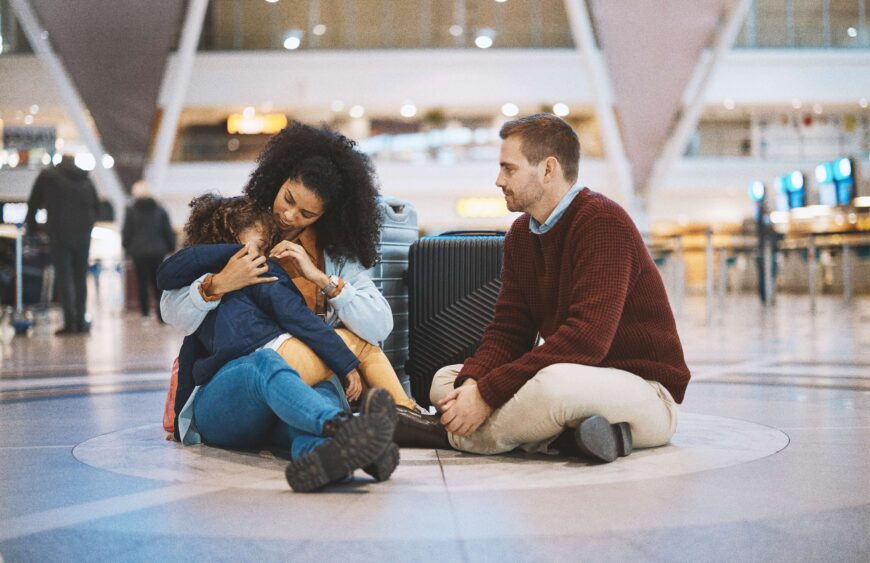
First, take a deep breath yourself before you do anything else. Your child is having a hard time, not giving you a hard time. Public meltdowns happen to every parent, and the people judging you have either never had kids or have forgotten what it’s like. Focus on your child, not the audience. Get down to their level, speak calmly, and if possible, move to a quieter spot. Sometimes kids just need to get the feelings out, and your calm presence helps them regulate faster than anything else.
What’s the best way to handle jet lag with kids while managing my own stress?
Jet lag is rough on everyone, and there’s no magic fix. Try to gradually adjust sleep schedules a few days before you leave if possible. Once you arrive, get everyone outside in natural light, which helps reset your body clocks. Keep the first day or two very low-key with plenty of rest time built in. Don’t expect anyone to function normally for at least a few days. And remember, you’re all in this together, so lower your expectations and just get through it one day at a time.
How do I manage my anxiety about traveling with kids on planes or long journeys?
Preparation helps tremendously with travel anxiety. Make lists of what you need, pack entertainment and snacks, and give yourself extra time. Practice those breathing techniques before you even get to the airport. Remember that most of what you’re worried about probably won’t happen, and even if it does, you’ll figure it out. Other parents have survived this, and you will too. Also consider using the 5-4-3-2-1 grounding technique when your anxiety spikes. It really does help pull you back to the present moment.
What should I do if my parenting partner and I are both stressed and starting to snap at each other?
This happens to pretty much everyone on family trips. Acknowledge it directly rather than letting it fester. Tag-team so each of you gets a proper break from the kids. Even thirty minutes alone can help you reset. Be gentle with each other and remember you’re on the same team, even when it doesn’t feel like it. Sometimes it helps to have a code word or signal for “I’m at my limit and need you to step in.” And don’t forget that you might both just need food, water, or sleep. Basic needs matter.
How can I make sure I’m not just surviving family travel but actually enjoying it?
Lower your expectations of what the trip should look like and focus on small moments rather than grand experiences. Notice when your kid laughs at something silly. Appreciate when everyone’s getting along, even if it’s just for ten minutes. Take photos of the real moments, not just the posed ones. Build in activities you genuinely want to do, not just things for the kids. And remember that enjoying family travel doesn’t mean enjoying every single minute. It means the good moments outweigh the hard ones and you’re present enough to notice them when they happen.