Important: This guide is intended to help with travel planning, not replace your child’s individual allergy or anaphylaxis action plan. We strongly recommend discussing your travel plans with your child’s healthcare provider and following their recommendations, especially if you’re planning an international trip.
Flying with kids already involves enough mental checklists. For parents of a child with a severe food allergy, those lists tend to be topped with one particularly worrying question: What happens if someone opens a bag of peanuts three rows away?
The reality is that you can’t control everything another passenger eats or every crumb left behind by whoever occupied seat 24A before you. There are, however, quite a few things you can do to protect your child before and during your flight.
In this guide, we’ll cover how to reduce the risk of accidental exposure, prepare for an emergency and, hopefully, take some of the anxiety out of flying with a child with food allergies. We’ll also look at a couple of common fears about allergies on airplanes and what the current evidence actually says.
What You'll Find in this Guide
How to prepare
What to check with your airline
How to reduce the risk of exposure on board
What food and allergy medication to pack
What the research says about airborn nut allergens on planes
How to prepare for an allergy emergency
Extra precautions to take
Flying With Food Allergies: Planning Is Key
If your child is at risk of a severe allergic reaction, start planning before you get anywhere near the airport.
The CDC recommends that travelers with severe allergies review their allergens and medication regimen before travel, make sure prescriptions will cover the whole trip, check medication expiry dates and have an up-to-date anaphylaxis action plan. If you’re travelling somewhere where replacement epinephrine/adrenaline auto-injectors or medical care may be difficult to access, your doctor may also recommend carrying additional devices.
For an international trip, it’s worth discussing your plans with your child’s allergist well ahead of departure, particularly if you’re heading somewhere unfamiliar.
Airline’s Allergy Policy: Check Before You Book
It’s always a good idea to ask the airline in advance about its policies on nut or peanut restrictions, buffer zones, pre-boarding to clean the seating area and onboard medical capabilities. Policies vary widely between airlines, so check directly with your airline to find out how it handles passengers with severe food allergies.
It’s also important to remember that an entirely allergen-free flight is generally impossible to guarantee. Even if an airline doesn’t serve a particular food, other passengers could bring their own snacks aboard. That sounds alarming, particularly if your child has a severe peanut or tree-nut allergy. There is, however, some reassuring research about what actually happens to allergens inside an aircraft — and we’ll get to that shortly.
Tell the Airline. Then Tell Them Again!
You told them when you booked.
Tell the check-in agent. Tell the gate agent. Tell the cabin crew.
You’re not being annoying. You’re making sure the people actually working this particular flight know about your child’s allergy.
Reconfirm your child’s food allergy at each stage of the airport process rather than assuming the information added to your booking has reached everyone who needs it.
At the gate, ask whether you can pre-board to clean your child’s seating area. Some airlines specifically allow this for passengers with food allergies, while others have different policies, so it’s worth asking rather than assuming.
Clean Your Child’s Seating Area
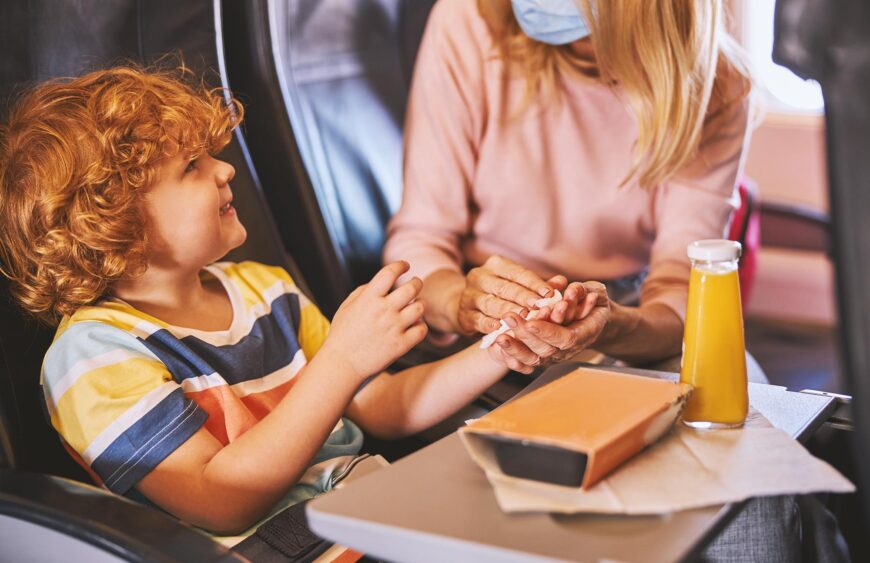
Once you’re on board, give the immediate seating area a good wipe-down.
That means the tray table, armrests, seatbelt buckle, screen controls and any other surface your child is likely to touch, which, depending on their age, may somehow include half the aircraft. Food residue on these surfaces can create a cross-contact risk if it gets onto your child’s hands, snacks or belongings, so give their immediate surroundings a thorough cleaning before they settle in.
Pack your own wipes somewhere easily accessible so you’re not digging through the overhead bin while everyone else is trying to board.
Pack Your Child’s Food Yourself
For a child with a serious food allergy, an airplane probably isn’t the ideal place to experiment with unfamiliar food. But you already knew that!
The solution: bring enough known-safe food from home for
the airport + the flight + delays + one more delay you really didn’t ask for.
The CDC advises avoiding foods without clear ingredient labels when travelling.
Even if your airline offers special meals, think carefully about whether you’re comfortable relying on one for your child. Airline catering may involve food prepared by third-party kitchens, and your ability to check ingredients or ask detailed questions about preparation and cross-contact can be limited.
Security and customs rules for food also vary by country, particularly for liquids and fresh foods. Check the official security rules for your departure airport and the customs regulations at your destination, but be prepared to fill the carry-on with enough provisions to feed a small kindergarten.
Flying With Epinephrine: Keep Your Allergy Kit in Your Carry-On. Always.
Never check the medication your child might need in an emergency. And if your child has been prescribed epinephrine, travel with not one, but two auto-injectors.
FARE recommends carrying two epinephrine/adrenaline auto-injectors at all times. For travel, the CDC also recommends discussing extra devices with your child’s doctor if you’ll be somewhere where replacement epinephrine or medical care may be difficult to access.
And carry-on really means within reach. Keep the auto-injectors on you or in a bag under the seat where you can get to them immediately. That also means not burying them in the overhead bin. An allergic reaction is not the moment you want to discover that your medication is three rows back behind somebody’s roller suitcase.
Keep auto-injectors in their original labelled packaging where possible. For international travel, the CDC also recommends carrying documentation from your healthcare provider explaining the medical need for injectable epinephrine, which may help if questions arise at security or customs.
Your allergy kit should also contain anything specified in your child’s individual emergency plan: your child’s other prescribed medication, allergy/anaphylaxis emergency action plan, prescription or doctor’s letter where appropriate, insurance information, and translated allergy cards.
And don’t rely on the aircraft having epinephrine available. Onboard medical-kit contents and the rules governing who can access and administer medication vary, so your child’s own medication should always be immediately available.
Peanuts Three Rows Away: How Worried Should You Be?
For passengers who have never dealt with severe food allergies, bringing a bag of nuts aboard may feel like an entirely ordinary snack choice. For a parent who knows that the wrong exposure can send their child into anaphylaxis, that same bag opening nearby can feel anything but ordinary.
Here’s the reassuring part.
A 2025 review of the available evidence found no evidence that peanut or tree-nut allergens spread through aircraft ventilation systems in a way that makes airborne transmission a likely cause of allergic reactions. The researchers found that food-allergic reactions are actually reported considerably less frequently during flights than on the ground, possibly because passengers with allergies take additional precautions when flying.
The CDC similarly notes reassuring evidence that inhalation-only or incidental skin exposure without ingestion is unlikely to cause a significant food-allergic reaction.
That doesn’t mean you should go easy on the precautions you normally take for your child. Individual allergies and medical histories differ, and your child’s allergist and emergency plan should always guide you.
It does mean, however, that you can focus much of your attention on the things you can reasonably control: your child’s food, hands and immediate seating area.
Make Sure the Adults Know the Emergency Plan
If Grandma, another parent or any other adult will be responsible for your child during the journey, make sure they understand the emergency plan too.
They should know where the epinephrine auto-injector is kept, how to use your child’s device, which symptoms the emergency plan tells them to watch for and when that plan says epinephrine should be administered.The CDC specifically recommends giving travel companions a copy of the allergy emergency response plan and making sure they know how to recognize a severe allergic reaction, where the auto-injector is and how to use it.
This is something important to sort out at home rather than discovering somewhere over the Atlantic that Grandma has no idea which pocket of the backpack the medication is in.
Flying Internationally? Learn the Language of Your Child’s Allergy
Food allergies become considerably harder to communicate when you don’t speak the local language.
Carry an allergy card listing your child’s allergens in the language of your destination. The CDC recommends translated food-allergy cards and emergency medical phrases for international travelers with severe allergies.
You can go one step further and learn the local words for your child’s allergens yourself.
Know how to say and recognize words such as peanut, milk, egg, sesame or whatever your child needs to avoid. Learn how to say that your child has a severe allergy, too. You may need it while buying food at the airport, reading packaging, talking to cabin crew or ordering food after you arrive.
If you’re travelling somewhere with an unfamiliar cuisine, research common ingredients before you go. The CDC also recommends checking local food-labelling regulations and learning whether your child’s allergens commonly appear in traditional dishes.
A Quick Food Allergy Checklist
Before heading to the airport, make sure you have:
✓ Checked your airline’s current food-allergy policy
✓ Notified the airline about your child’s allergy
✓ Packed enough safe food for the airport, flight and delays
✓ Packed two epinephrine auto-injectors and kept them immediately accessible
✓ Checked medication expiration dates
✓ Packed your child’s allergy/anaphylaxis action plan
✓ Packed wipes for the seating area
✓ Added translated allergy cards for an international trip
✓ Learned the local names for your child’s allergens
✓ Made sure every responsible adult knows where the epinephrine is, and how to use it
Sure, travelling with a food-allergic child requires more preparation, but it doesn’t automatically take family travel off the table. Know what you can control, prepare for what you can’t, keep the emergency medication close — and go show your kid some more of the world!
We use cookies to ensure that we give you the best experience on our website. If you continue to use this site we will assume that you are happy with it.