
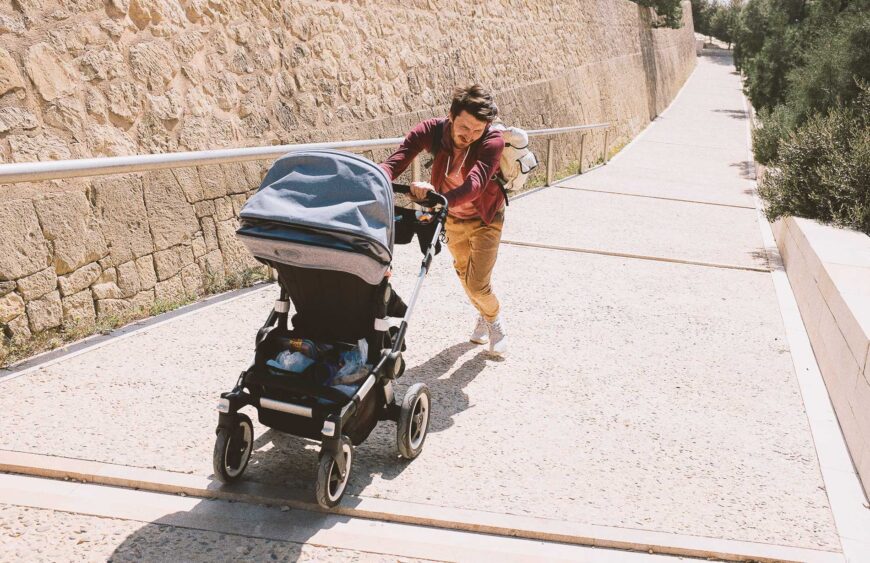
The Wheels We Rely On
Did you ever have that moment where you’re standing at the base of a metro staircase with a overly-bulky stroller, a sleeping toddler, and you’re just looking up at an endless stream of steps with no elevator in sight? Perhaps you’re even silently promising yourself you’ll plan better tomorrow? Traveling with a stroller in big cities can feel like a full-body workout, but it doesn’t have to. Once you know how each city works, where it welcomes wheels and where it doesn’t, moving around becomes less of a battle and more of a rhythm. Unfortunately we don’t usually have enough time to figure out the ebb and flow of every city we visit on our tour of half of European.
So we have to figure out the shortcuts, knowing what to expect, and finding those little wins that make urban travel with strollers smoother for everyone. From the compact stroller you choose to the train you board and even the map app you use.
What you’ll find in this guide:
Why Cities Can Feel Harder with Strollers
Choosing the Right Stroller for Urban Travel
Mastering Public Transport with Wheels
Using Tech to Find Stroller-Friendly Routes
Best and Worst Cities for Strollers
When a Carrier Is Better
Street Smarts for City Walks
What Parents Would Do Differently Next Time
Finding Your Own Rhythm
FAQ’s
Why Cities Feel Harder with Strollers (and How to Rethink That)
City travel tests strollers in ways suburban life never will. Narrow sidewalks, broken curbs, revolving doors, and that one café you can’t fit through. It’s okay to shake your fist and curse at half of Europe. Who knew most strollers were wider than their two-tonne solid wood doors?! But it’s not that all European cities aren’t built for families; it’s that they’re built for everyone, and parents have to learn to move differently within them.
The trick is to think like a local parent. Most urban families already know which metro entrances have elevators, which tram stops are level with the curb, and which parks have ramps. The rest of us just need a little catching up. Once you know where to find that kind of information, the city starts opening up a bit. Which is why pairing this article with Safety Tips for Crowded Transit Systems is such a good move. The more you understand how a city flows, the more confidently you’ll move through it, tiny wheels and all.
Choosing the Right Stroller for Urban Travel
Not all strollers are made for city travel. The bulky, plush, all-terrain models that work beautifully in parks are the same ones that will make you curse every narrow train door. What you need is something compact, quick to fold, and light enough to carry with one hand. Bonus points if it stands on its own once folded. It’s a tiny and often overlooked design detail that feels like magic when your hands are full.
If you’re flying in, check what your airline allows as cabin baggage. Some ultralight models fit in the overhead bin, meaning you’ll have your stroller waiting when you land rather than on a luggage carousel. And if your trip is short or your destination has narrow sidewalks, consider renting one locally.
Mastering Public Transport with Tiny Wheels
Getting a stroller on public transport takes a mix of timing and intuition. Try to ride outside of rush hours. Late mornings or early afternoons are when trains and buses have space to spare. On metros, look for the wide-access gates or elevators near the station’s side entrances. Once on board, position yourself near the doors but not blocking them, ideally by a corner or side wall where the stroller can stay stable without blocking traffic.
Buses and trams often have designated stroller zones marked with a symbol on the floor. These spaces are first-come, first-served, so if they’re full, wait for the next one. It’s rarely more than a few minutes, and it’s worth it. Having your wheels secure and everyone calm beats forcing your way into a packed bus.
In cities like Berlin, Sydney, or Stockholm, your Family Transit Pass often covers ferries too. A quieter, stroller-friendly way to move between neighborhoods. If you missed that article, it’s worth a read; ferries are often the calmest, cheapest, and most stroller-friendly rides in any city.
Using Tech to Find Stroller-Friendly Routes
One of the best-kept secrets for parents exploring cities is something hidden right inside Google Maps. If you open the app and switch on wheelchair-accessible mode, you’ll instantly see routes that account for elevators, ramps, and step-free station access. It’s meant for mobility users, but it’s a lifesaver for anyone with a stroller.
This feature changes how you move through a city. Instead of getting stuck at a flight of stairs, you’ll automatically be guided toward the right exits. Many parents don’t even know it exists until their second or third trip. But once you’ve used it, it becomes part of your travel toolkit. Just don’t forget to turn it off after your trip. Apps like Citymapper and Moovit offer similar accessibility filters and can even show real-time elevator outages at stations, which saves you from a lot of “are you f***ing kidding me?” moments mid-journey.
Best and Worst Cities for Strollers
Some cities are genuinely easier than others. In Amsterdam, Copenhagen, and Tokyo, strollers are part of the urban landscape. Public transport is accessible, sidewalks are smooth, and even cafés tend to have space for parents. Singapore also deserves a gold star for clean, wide paths and public buildings that seem built with families in mind.
Then there are the cities that make you earn it. Paris is notorious for metro stations without lifts, Rome has more cobblestones than common sense, and Istanbul’s steep hills can turn any stroller into a strength-training session. Basically in those cities, you better not have skipped leg day. Or arm day too, now that we think about it. In those places, switching between a stroller and a carrier depending on the day’s plans makes life easier. Think of it as adapting, not compromising.
When planning your route, mix up your days: stroller days for parks, promenades, and public transport; carrier days for crowded markets, steps, and historic areas. You’ll enjoy both more when you stop trying to force one solution for every situation.
When a Carrier Is Better
Sometimes wheels just don’t make sense. If you’re exploring hilly cities, historic neighborhoods, or old transit systems with endless stairs, a carrier saves both your back and your patience. It’s also easier during busy times when maneuvering a stroller feels like threading a shopping cart through a rush-hour crowd.
For babies, soft structured carriers or wraps are ideal for flexibility. For toddlers, look for ergonomic backpack carriers with padded straps, especially if you’ll be walking long distances. Temperature matters too. In warm cities, opt for breathable mesh fabrics and light clothing layers underneath.
There’s no perfect age to switch between stroller and carrier, it’s about matching the tool to the day. Sometimes the carrier is for naps, sometimes the stroller doubles as a portable high chair. Your goal is freedom, not minimalism.
Street Smarts for City Walks
Sidewalks tell you everything about a city’s attitude toward families. Some are wide, smooth, and shaded. Others are cracked, slanted, and full of delivery bikes. Learn to read the terrain. In older cities, expect uneven stones and narrow alleys; in newer ones, plan around curbs and crosswalk timing.
If you find yourself in a tight area like a market or festival, pull over to the side instead of stopping in the middle of the crowd. Locals appreciate it, and it keeps you from feeling rushed. When entering shops or cafés, a polite “Can I bring this in?” usually gets a smile and a nod even in places that technically don’t allow strollers. It’s all in the approach.
By the way, when in doubt about direction, find other parents. They always know where the elevators, ramps, and shady benches are.
What Parents Would Do Differently Next Time
Every traveling parent has a small list of things they’d change after a trip. Some wish they’d packed lighter, others regret bringing a stroller that couldn’t handle curbs. A few realize halfway through a city stay that they never once needed the rain cover they carried for two weeks.
The best advice tends to come from trial and error: pack what you actually use, not what you might need. Choose equipment that matches your rhythm, not the influencer version of travel. That sh*t does not exist. Parents on forums often say they wish they’d done more research on local rentals. Not because their own stroller was bad, but because traveling without it felt unexpectedly liberating.
If you haven’t yet, check out our upcoming guide on Travel Gear for Getting Around Cities. It breaks down exactly which items are worth bringing and which you can easily borrow or rent once you arrive.
Finding Your Own Rhythm
The first few days in any big city can feel like a maze of stairs, bumps, and tight corners. But somewhere between the first awkward metro ride and the last park stroll, you find your flow. You start noticing the patterns. When the crowds ease, which side streets are smooth, which café keeps the door open wide enough for you to roll through without drama.
Navigating cities with a stroller isn’t about perfection. It’s about finding balance, patience, and small wins. The elevator that works, the tram that stops at street level, the stranger who holds the door without you asking. Over time, those moments add up. And one day, you’ll realize you’re moving through the city like you belong there just with slightly better wheels.
Too Long? Here are the most common questions we’re asked.
It depends. Northern European and East Asian cities tend to be more accessible, while older cities with historic infrastructure can be challenging.
Usually yes, but aim for non-rush hours. Look for stroller icons marking accessible doors or zones.
Lightweight, quick-fold, and compact models handle crowds best. Avoid large wheels unless you’re tackling cobblestones.
Use wheelchair-accessible mode on Google Maps or Citymapper for step-free navigation and elevator info.
If you can, yes. Use the stroller for long walks and naps, and the carrier for tight spaces and stairs.