Train boredom just hits differently
Trains occupy a funny middle ground when it comes to family travel. They aren’t as restrictive as airplanes, where kids are strapped down for hours, and they aren’t as high-stakes as cars, where one meltdown can derail the whole drive. Instead, trains offer a little more room, a little more freedom, and a lot more views. That freedom, however, comes with its own challenge. Kids can stretch, wander, and even run if you’re not paying attention. And once the novelty of being on a train wears off, boredom creeps in faster than you’d think.
On a scenic route through mountains or coastlines, the views do a lot of the heavy lifting. But on long, flat stretches of farmland or suburban sprawl, the question eventually arrives: “What can I do now?” Parents who get through train journeys smoothly aren’t the ones who try to fight boredom as it appears; they’re the ones who plan for it before the doors even close.
Preparing entertainment before you board
The train ride itself can feel deceptively easy. Just show up, find your seat, and roll. But the families who make it look effortless are usually prepared in advance. They packed small activity bags, downloaded shows to tablets before leaving, and stashed away one or two surprise toys that only come out mid-journey. The idea is less about stuffing kids with things to do and more about pacing thoughout your journey. If you hand them everything at once, you’ll burn through the options by the first hour. Stretch it out, and you buy yourself windows of peace throughout the ride.
It’s the same principle we cover in the Essential Carry-On Packing List for Families: the difference between “bare minimum” and “thank goodness we brought this” comes down to preparation. Even a short regional hop is easier when kids have something engaging within reach, and on longer journeys, it’s not just about entertainment, it’s about keeping your sanity.
Making the most of the scenery
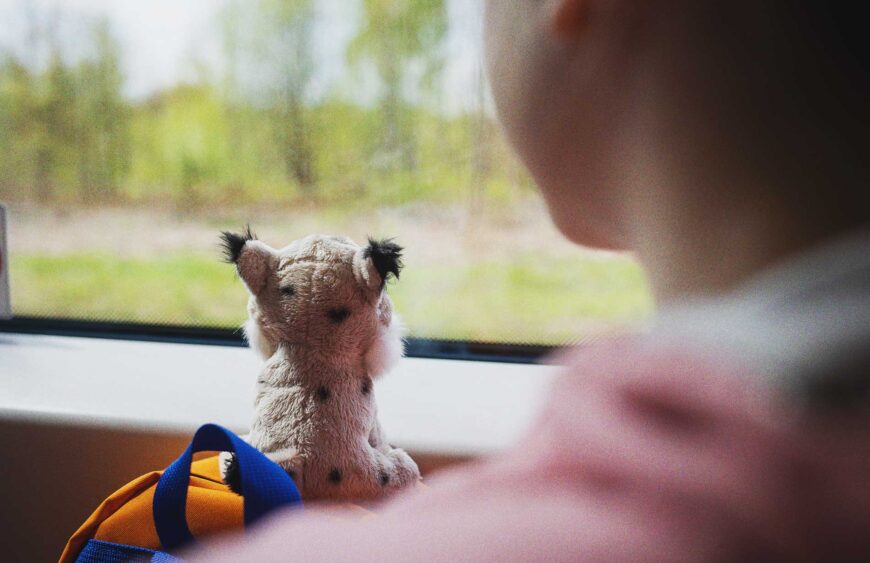
One of the biggest perks of train travel is that the world outside the window becomes part of the entertainment. Kids who get antsy in cars sometimes find themselves glued to the glass on a train, pointing out rivers, castles, or farms as they pass. Parents can lean into this by turning the scenery into a game. Count how many tunnels you go through on the Bernina Express, spot castles on Germany’s Rhine Valley line, or look for reindeer signs on Scandinavian routes.
It doesn’t have to be a formal activity. Sometimes all it takes is calling attention to what’s out there. When kids realize they’re not just passengers but observers, the journey becomes more interactive. That’s why in Best European Train Routes for Kids we highlighted rides where the view itself becomes the main attraction. Choosing the right route is sometimes the best entertainment strategy of all.
Classic travel games that actually work on trains
Certain old-school travel games lose their magic after the hundredth round in a car, but trains breathe new life into them. “I Spy” suddenly has endless possibilities like tunnels, luggage racks, station signs, and fellow passengers. Counting games take on new twists: how many blue trains pass, how many stations before arrival, or how many hats spotted in the carriage. Kids are surprisingly inventive and often come up with their own variations that keep them busy far longer than you’d expect.
This is also where the worlds of road, air, and rail overlap. The same imagination-based games that work wonders on planes or in cars adapt beautifully to trains. That’s why in 20 Simple Games to Play with Kids on Planes (No Toys Needed), we dig into a bigger list of ideas that require nothing but your imagination. Trains may have wider windows and aisles, but the principles are the same: keep it simple, interactive, and fun enough that kids forget to ask how much longer.
Activities that keep hands busy without the mess
Trains offer more freedom of movement than cars, but space is still somewhat limited. Activities that keep little hands busy without turning into a disaster are worth their weight in gold. Parents often take on things like sticker books, magnetic puzzles, or simple drawing pads. Unlike glitter, play-dough, or complicated construction kits, these don’t end up all over the cabin or god forbid in your neighbour’s lap.
For some families, it’s also the perfect time to introduce a new travel toy. On our Travel Toys & Adventure Kits page, we focus on items that are compact, quiet, and built for confined spaces. The best activities aren’t just distractions but rather tools for creating moments of calm in an otherwise stimulating environment.
Using tech without letting it take over
No matter how well you plan, there comes a point when screens are the easiest solution. And that’s okay. The key isn’t avoiding tech altogether, but using it in a way that supports the journey instead of taking it over. Downloading shows or movies ahead of time saves you from the heartbreak of weak Wi-Fi. Audiobooks can keep kids absorbed without requiring them to stare at a screen. Even interactive maps, where kids can follow the route in real time, turn a tablet from pure distraction into part of the experience.
It’s about balance. Too much screen time and the train becomes just another background to a cartoon. Too little, and parents may find themselves drained from constant improvisation. Families who get it right treat screens as one tool in a larger kit, not the whole kit itself.
Food as a distraction (and occasional lifesaver)
Few things reset a child’s mood faster than a snack. On trains, food isn’t just fuel, it’s entertainment. Pulling out a small stash of crackers, fruit, or sandwiches gives restless kids something to focus on besides the passing minutes. It breaks up the ride, creates natural pauses, and can even be turned into a little picnic right at your seat.
Of course, not all snacks are created equal. Sugary treats may seem like quick wins, but they usually backfire in the form of energy bursts just when you want calm. The same principles we cover in Best Road Trip Snacks for Children apply here: choose foods that are filling, tidy, and easy to pack. A banana and a cereal bar go further than candy when your goal is peaceful travel.
Letting kids move safely on board
Perhaps the greatest gift of train travel is that kids can move. Unlike cars or planes, where they’re strapped down for hours, trains allow for little legs to stretch. But with that freedom comes the need for boundaries. Parents who thrive on trains usually set clear rules early: children can walk to the café car, but only with an adult; they can stretch in the aisle, but they don’t run; they can explore a little, but they check in often.
Movement isn’t just for exercise, it can be used for resetting attention spans. A five-minute walk through the carriage can buy another half hour of calm in the seat. When used wisely, those breaks prevent boredom from turning into meltdown. Our Safety Tips for Train and Bus Travel guide digs into the details, but the principle is simple: safe movement is one of the best antidotes to train boredom.
Turning the ride into part of the adventure
At its best, keeping kids entertained on trains isn’t about juggling distractions until you arrive. It’s about reframing the ride itself as part of the holiday. When children are engaged with the scenery, involved in small games, and given space to move safely, the hours pass more easily. Snacks and tech have their place, but they work best as supplements to a broader plan.
Parents often find that once they stop treating the train as “lost time,” the journey becomes one of the most enjoyable parts of the trip. Kids remember the castles outside the window, the silly games in the aisle, and the little picnics at their seat. Parents remember the rare sense of calm that comes with not having to drive or navigate. Together, those memories add up to more than just a way to get from one city to another and instead, they become part of the story your family tells later.
Too Long? Here are the most common questions we’re asked.
Mix preparation with flexibility: pack activity bags, encourage games, use the scenery, and balance tech with hands-on play.
Simple, portable ones like sticker books, drawing pads, audiobooks, and classic games such as “I Spy” or counting tunnels.
Yes. Movement is one of the biggest advantages, but it should be supervised with clear rules to keep it safe.
Screens are useful, but best used in moderation. Download shows, audiobooks, or maps in advance, and combine them with non-digital activities.
Filling, tidy options like fruit, crackers, or cereal bars work best. Avoid overly sugary snacks that can spike energy.