Flying with Kids Group Questions Answered

10 Hacks For Flying Alone With Kids To Make Any Trip Easier


cheerful-toddler-with-toy-airplane-with-and-father

Flying alone with young kids has a very specific design flaw: you only have two hands, while the airport seems to require at least six. Someone needs a snack, someone wants carrying, and the passports have mysteriously worked their way to the bottom of the nappy bag.

You’ve probably heard the usual advice: pack light, bring plenty of entertainment and cut yourself some slack. All useful. There are also less obvious services, clever bits of kit and small changes to your setup that can make the awkward parts of the journey considerably easier. Some give you another pair of hands; others help you make better use of the two you already have.

We’ve covered paperwork, seating, bathroom breaks and other essentials in our Flying Solo With Kids: Survival Guide. Here, we’re looking at the options you might wish you’d known about before your last trip. Parents in our Flying and Travelling with Kids community helped shape this list, including the reminder that carrying less often makes life easier.

Hack 1: Airport Meet & Assist - another adult on your team

Picture the stretch between the taxi and check-in. You have a baby in a carrier, a toddler in a stroller, a car seat, a nappy bag and two suitcases. Getting everything through the doors is already a logistical puzzle, especially at an airport you don’t know.

Some airports offer paid Meet & Assist services, where a host meets you at an agreed location and helps you navigate the airport. Heathrow specifically lists travelling alone with children as a situation where its service can be useful. Depending on the package, support may cover departures, arrivals or connections.

Before booking, explain exactly what you’re bringing: “I’ll be alone with a baby and a three-year-old, a stroller, a car seat and two suitcases.” Ask where the host meets you, whether they help carry luggage and where the service ends. If getting from the taxi to check-in is the part you’re dreading, you’ll want someone who meets you before that particular circus begins.

Search your airport’s official website for “Meet & Assist” and check what’s included in the price. Booking help for the most awkward stretch could leave you with a little more energy for the flight, and fewer reasons to regret packing that second suitcase.

Hack 2: Luggage porters - let a professional wrestle the suitcases

Porters are easy to overlook when you’re busy checking passports, packing snacks and negotiating which teddy gets to come. But if you’re travelling alone with children and several bags, having someone handle the luggage can make an awkward stretch considerably easier. At some airports, you can book help between the drop-off point and check-in, or at baggage reclaim when you arrive.

Before booking, confirm the meeting point, how many bags the price covers and how far the porter can accompany you. Mention bulky items such as a car seat or stroller, too. If you’ve already booked Meet & Assist, check whether luggage handling is included before paying for a separate service.

Give your arrival airport just as much thought as your departure airport. After a long flight, collecting three suitcases while holding a sleeping child can feel like the final round of a competition you never entered. That might be the moment when you’ll appreciate another pair of hands most.

Hack 3: Save your goodbyes for the gate

Most of us assume the non-flying adult has to wave goodbye before security. At some airports, visitor-pass programmes let approved friends or relatives into the departure area. That could mean having someone occupy the toddler while you repack after security, take turns getting food or simply help you get everyone to the right gate.

Seattle-Tacoma’s SEA Visitor Pass is one example. Visitors can apply on the day or up to seven days ahead, subject to approval and daily availability. They need accepted identification and must go through security themselves. The pass doesn’t grant access to international passport control, so it won’t let someone meet you inside that area after an international arrival.

Check your airport’s official website for “visitor pass” or “terminal access programme”. You can also ask your airline whether it issues escort or gate passes for your circumstances, though these have separate eligibility rules. Confirm access before making plans around it; a helpful grandparent and a convincing smile won’t necessarily get you through security.

Where a programme is available, having your helper stay until boarding can make the airport stretch much easier. You still do the flight yourself, but you get to start it without having already managed every queue, toilet trip and snack negotiation alone.

Hack 4: Help on the flight - travelling with a companion

Getting through the airport is one thing. Then comes the flight, where you might need to feed the baby, entertain the toddler and somehow eat your own meal. Cabin crew may help when they can, but their duties mean you can’t count on them for regular childcare or a spare pair of hands whenever you need one.

A paid travel companion is an option worth exploring. Juurnee connects travellers who need assistance with people willing to accompany them on their flight. You post your journey and the help you’re looking for, review applications and choose someone who feels like a good fit. Its current focus is London–Sydney travel, although you can post requests for other routes. Finding a suitable companion depends on your dates, route and the people available.

For a solo parent, that could mean agreeing on help with bags, keeping one child occupied while you feed another, or getting a chance to eat while your food is still recognisable. Discuss the practical details before committing: the children’s ages, the companion’s childcare experience, seating arrangements and exactly what help you expect. A video call beforehand can help you get to know each other and decide whether you’d feel comfortable travelling together.

Juurnee says companions must complete identity verification and offers an arrangement that holds payment until after the journey. You should still ask about relevant experience and qualifications, and check the current costs and terms before making plans. For a long flight with young children, knowing you have another adult on your team could be a considerable relief.

Our Partner:

Every Juurnee is better with company

Juurnee connects travellers who need help on their flight with travellers who want to get paid to fly. Everybody wins!

Our Partner:

Juurnee connects travellers who need help on their flight with travellers who want to get paid to fly. Everybody wins!

Hack 5: Map out the airport before you get there

Looking up airport bathrooms two days before a flight might feel like overdoing it. But when you’re alone with a baby who needs feeding and a toddler announcing “I need a wee” with increasing urgency, knowing where to go is rather useful. Open your airport’s official terminal map and locate the family toilets, changing facilities, feeding spaces and any play areas along your likely route.

Use the airport’s own map or app for terminal facilities. For example, the Heathrow app provides maps, directions and live flight updates. Check which terminal you’ll use and, if you have a connection, how you’ll move between terminals. A lovely play area in another building is unlikely to improve anyone’s afternoon.

Save screenshots of the useful bits so you can access them without relying on airport Wi-Fi. Keep checking the departure screens for your current gate, though: a screenshot won’t know that your flight has moved to the other end of the terminal.

Pro Tip: Outsmart the automatic flush

If your toddler is terrified of toilets that flush without warning, keep a few Post-it notes in your bag. Cover the automatic flush sensor while they use the toilet, then remove the note and flush when they’re ready. A tiny square of paper could save you a very lengthy toilet negotiation.

Give the journey after landing the same treatment. Save your accommodation address, transfer confirmation, driver’s contact details and pickup instructions together, somewhere easy to find. A screenshot showing the exact meeting point can spare you a surprisingly exhausting exchange of “We’re outside” and “Outside where?”

Google Maps is useful for downloading the area around your destination before travelling. Offline maps support driving navigation within the downloaded area, but walking and public-transport directions need a connection. If you’re taking a train or bus, save the route, stop names and relevant timetable separately. Your tired future self will appreciate having fewer things to figure out.


Hack 6: Ride-on luggage - useful when your child will actually ride

A ride-on suitcase gives your child somewhere to sit during those long walks through the terminal and might make reaching the gate more appealing than being carried. It can work well for a child who stays seated and follows instructions. The important question for a solo parent is whether you can manage it alongside everything else you’re bringing.
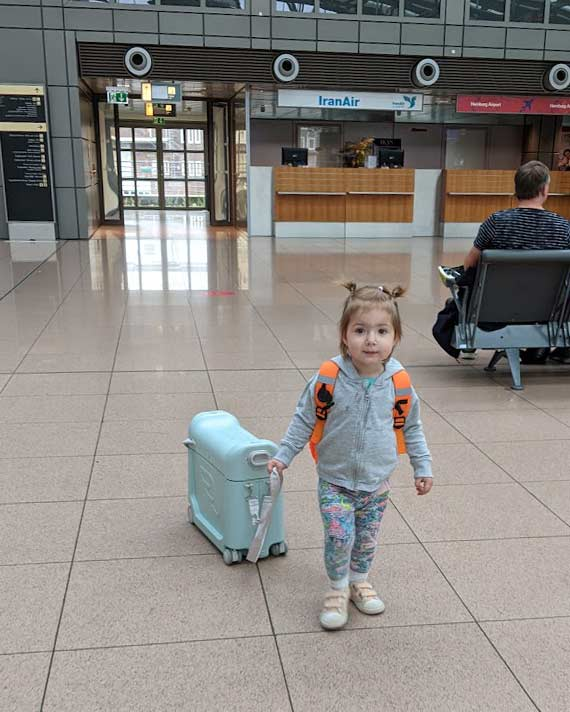
Two options worth considering are Trunki, a straightforward ride-on suitcase recommended for ages three to six, and, which combines ride-on luggage with a seat-extension or bed function. If that onboard feature is the attraction, confirm whether your airline permits it and in which seats before buying. Check the current product’s age and weight limits and your cabin-baggage allowance, too.

The catch is the towing. If you’re already pushing a stroller and pulling your own suitcase, you may have run out of hands. And when your child decides they’d rather walk or demands to be carried, you still have their suitcase to move. Keep riding slow and supervised in busy terminals; fellow passengers are unlikely to appreciate an impromptu slalom.

Try the complete setup before travelling, including what happens when your child gets off. Borrowing one for a trial can be more useful than a promotional video featuring a suspiciously cooperative preschooler. If it replaces a bag you were bringing anyway and helps your child cover the distance, it could earn its place.

Hack 7: A carrier, the kind you can put on without an assistant

A baby carrier can earn its place the moment you hand over your stroller at the gate. It also helps with stairs, long walks and those occasions when your child wants carrying while you still have bags to manage. For solo travel, the useful question is: can you put it on, adjust it and get your child settled without another adult sorting out the straps?
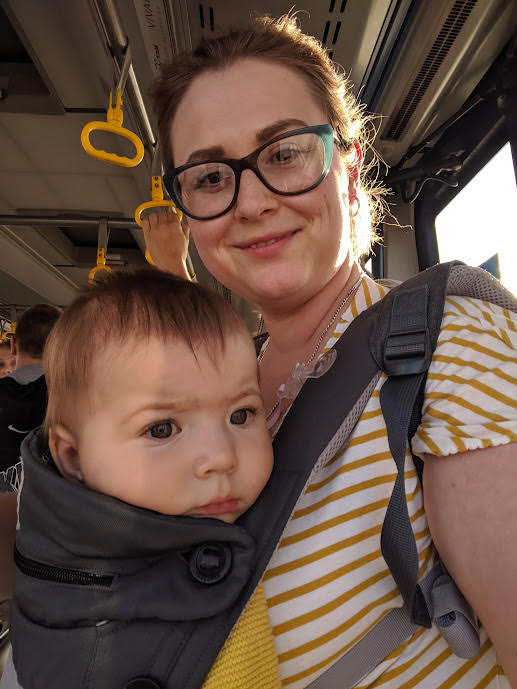
Two options worth exploring are Ergobaby Embrace for smaller babies, with a stated weight range of 3.2–11.3 kg, and Boba Air for children within its 15–45 lb range, roughly 7–20 kg. Follow the minimum age, weight and developmental requirements for the model you choose. The Embrace uses crossed shoulder straps; the Boba Air packs into its own storage pocket, making it worth considering as a backup when bag space is tight. Fit and comfort still need a trial with your own child.

Our community was divided on strollers: some parents found them indispensable, while others ended up carrying their child and managing an unwanted stroller. A compact carrier can help during boarding and after landing, particularly if your stroller is returned at baggage reclaim. Check where you’ll hand it over and where you’ll get it back before deciding what to bring.

Practise before the trip, including taking your child out and putting them back in. Check whether your chosen carrier actually leaves both hands free: some hip seats and carrying aids still require a supporting hand. That detail matters when your other hand is already occupied by a suitcase or a small person determined to walk in the opposite direction.

Keep your child’s face visible and airway clear, and follow the carrier’s fitting instructions. At security and on board, follow staff directions about when it must be removed. An everyday carrier doesn’t replace an approved aircraft restraint, so check your airline’s rules before relying on it during the flight.

Hack 8: Organise your carry-on “grab-and-go” style

A well-packed bag should let you find what you need while holding a child, without emptying half its contents onto the floor. Keep passports and valuables in a secure, accessible crossbody pouch, and organise your backpack into small kits you can pull out for each task: food together, activities together, changing supplies together. The real test is whether you can reach the wipes before the spill reaches your trousers.

A mini changing pouch is particularly useful: one nappy, a few wipes, a compact changing mat and a bag for soiled items. Keep it within easy reach so you can take just that pouch into the aircraft lavatory. Refill it after each change; discovering that your emergency kit contains only an empty wipe packet is a deeply unhelpful plot twist.

Use the same approach for snacks and entertainment. A small snack pouch and a separate activity pouch can move easily from your backpack to the space under the seat, so you spend less time rummaging overhead. Choose containers your child can manage where appropriate, and keep anything you’ll need during the flight in your accessible bag.

Pro Tip: Pack a spare outfit for yourself

Your child has spare clothes. Excellent. Now pack some for yourself, because a nappy blowout or spilled drink rarely respects personal boundaries. A lightweight top and bottoms will do. Don’t ask us how we figured that one out.

You probably already own suitable zip pouches or small containers. Before buying anything, pack your setup and rehearse a few awkward moments: retrieve a passport, find a snack, fold the stroller and pick up the bags. Discovering that something takes three hands in your living room gives you time to rearrange it before departure.

Hack 9: Consider booking your child their own seat

Several parents in our community named booking their child a separate seat as the change that made the biggest difference. If your child is under two and eligible to travel on your lap, another seat can be a substantial extra expense. If your budget allows, having somewhere suitable to settle them on a long flight can give your arms a break and make meals, bags and everyday juggling easier.
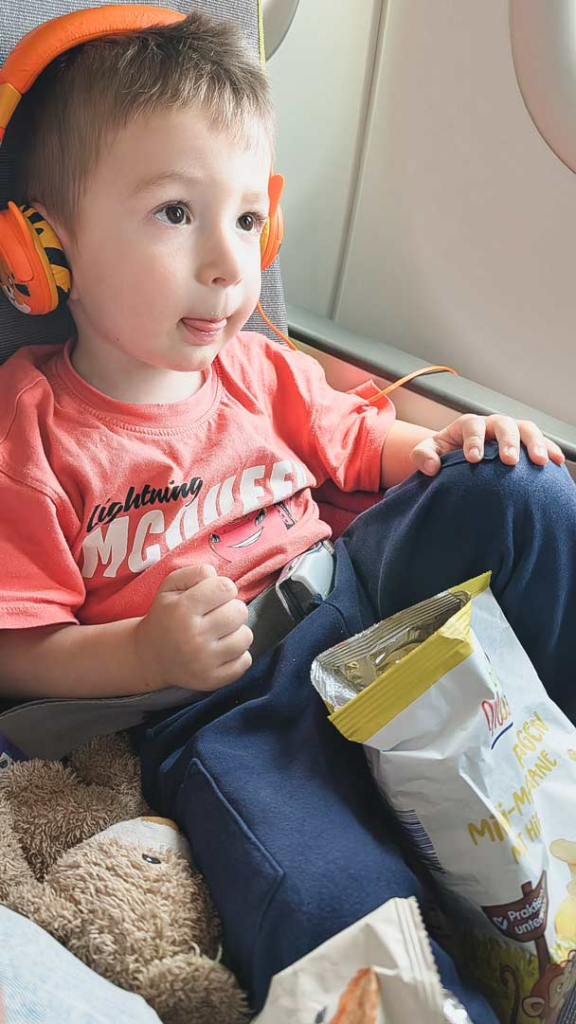
A separate seat also lets you use an appropriate, approved child restraint. For US flights, the FAA recommends children under two travel in their own seat in an approved child restraint system, rather than on an adult’s lap. The seat alone doesn’t provide the support and protection a small child needs.

Before booking, check your airline’s requirements for your child’s age and size, which restraints it accepts and where they can be installed. An approved car seat may be suitable; an aviation restraint such as CARES is another option for children who meet its requirements and where the airline permits it.

Bonus tip: Ask the gate agent whether an adjacent empty seat is available. Some community members were helped with seating changes, but availability and airline policy decide what’s possible. Treat any extra space as a welcome bonus; book the seat if you need to be certain you’ll have it.

Hack 10: Airport lounges - give yourself a break before take-off

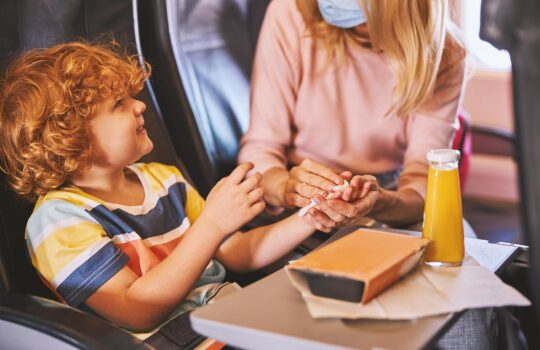
Having somewhere to sit, eat and organise yourself before boarding can be appealing when you’re the only adult managing everything. Food and drinks may be included, and some lounges have family facilities. Check what your chosen lounge actually offers; a play corner is a bonus, not something to assume.

Check the actual lounge before paying. Does it welcome children, what does their entry cost, and is there food your family will actually eat? Look at its location, opening hours and maximum stay, too. A lounge near your gate might be useful; one requiring a long detour could add another job to the list. Heathrow, for example, lists lounges that welcome children, alongside separate, free terminal play areas.

A lounge can offer a more comfortable base, but you’ll still need to supervise your child and belongings. If your toddler mainly needs a lot of space to move, a terminal play area might suit you better.

Pro Tip: Your card might already get you into a lounge

Before paying for a lounge, check your credit card’s benefits — some, including certain AmEx cards such as Platinum, already include access. Check whether activation is required and whether your children are covered. You might have a more comfortable airport wait sitting in your wallet.

Final thoughts: make room for the unpredictable bits

One message came through repeatedly in the community comments: take less to carry and leave some room for things to go differently from the plan. A familiar carrier, an accessible changing kit or help with the bags can make a real difference. Choose the options that solve the awkward parts of your particular journey, rather than trying to fit all ten into one trip.

Several parents also said their flights became easier when they stopped counting on a perfectly timed nap. Prepare for your child to be awake, keep the essentials close and take any sleep as a welcome bonus. You can be well prepared and still have a difficult hour; it doesn’t mean you chose the wrong flight or failed some secret parenting test.

A quick heads-up: Some links on this page are affiliate links. If you buy something through them, we may earn a small commission at no extra cost to you. It helps us keep Tots in Tow running (and the coffee flowing). But don’t worry — we only recommend things we’d genuinely suggest to fellow travelling parents. Commission or no commission, our recommendations stay the same.

Too Long? Here are the most common questions we’re asked

Can I book airport help when flying alone with children?

Some airports offer paid Meet & Assist or porter services. Check where the help starts and ends, and whether luggage handling is included, so you book support for the part you actually need.

Can someone accompany me to the gate without a flight ticket?

At airports with visitor-pass programmes, approved non-flying visitors may be able to accompany you beyond security. Availability and identification requirements vary, so confirm the rules before relying on a helper coming through with you.

Is a carrier or stroller better for solo travel?

It depends on your child and everything else you need to manage. Practise your complete setup and check stroller handover and return arrangements; a carrier can be particularly useful between the aircraft and baggage reclaim.

Is airport lounge access worth paying for with children?

It may be worthwhile for a long wait if the lounge welcomes children, offers useful facilities and is conveniently located. Compare the total family cost with other options and check whether your card already includes access.

How can I get help on the plane when flying alone with kids?

Travel-companion services such as Juurnee connect you with paid companions who can accompany you on your flight. Discuss the help you need, their childcare experience and seating arrangements before committing; availability depends on finding a suitable match for your journey.