Emergency Contacts and Travel Safety Sheets for Families
Why a simple sheet matters more than you think
When families travel, the focus is usually on tickets, luggage, and snacks. Very few parents think about what happens if they’re separated from their child, lose a phone, or face a medical emergency abroad. Yet, those “worst-case” moments do happen, and when they do, the difference between panic and resolution often comes down to a single sheet of paper.
Imagine your child gets separated in a busy train station, and instead of trying to remember your foreign hotel’s name, they hand over a card with your contact details in the local language. Or picture arriving at a hospital where staff don’t speak English, and you’re able to hand them a sheet with your child’s allergies, medication list, and your insurance number. These aren’t luxuries, they’re safeguards that buy you time and reduce confusion when things go wrong.
Why emergency contact sheets are essential for traveling families
Phones get lost. Wi-Fi drops. Batteries die at the worst moments. Parents who rely entirely on their smartphones for important numbers often discover this the hard way. An emergency contact sheet acts as a low-tech, always-accessible backup that can bridge the gap when technology fails.
For children, it can mean the difference between being lost and being quickly reunited. For parents, it can smooth interactions with local police, medical staff, or even kind strangers trying to help. The very act of creating one, forces families to think through their safety plan like who to call first, what details are most critical, and how to make them understandable across languages.
What to include on a child’s safety card
A child’s version should be short, clear, and written so that even a stranger can quickly understand the basics. At a minimum, it should include the child’s name, the parent or guardian’s name, a phone number that works abroad, and the address of the hotel or accommodation. For younger children, adding a line like “I speak English” or “Please call my parents” in the local language is helpful.
Parents often debate how much detail to include. Some are hesitant to list full addresses for safety reasons. A good compromise is to include the hotel name, city, and country, plus your phone number. This way, staff or police can still track you down without revealing more than necessary.
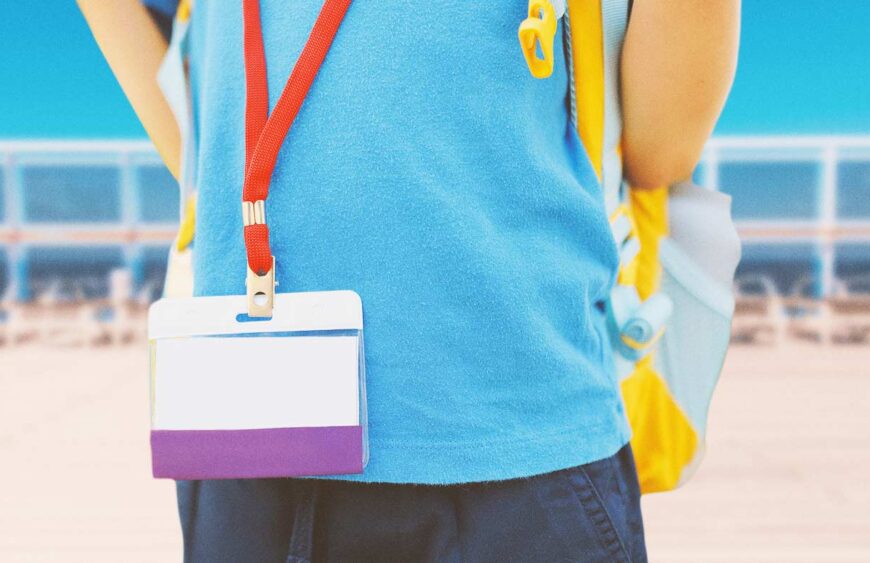
The format matters too. Laminated cards that slip into a lanyard or pocket last longer than paper slips. Some parents sew them into clothing tags, while others use medical-style ID bracelets. The goal isn’t style; it’s making sure the information stays with your child no matter what.
How to build a parent’s travel safety sheet
Parents need a more detailed version, usually a full page, stored in a bag or folder. This document should cover the family’s names and birthdates, passport numbers, insurance policy details, emergency contacts back home, and a local embassy or consulate phone number. Many parents also list known allergies, medical conditions, and regular prescriptions for each child.
This sheet isn’t just for your benefit, it’s for whoever is helping you in an emergency. If you’re in an accident and can’t speak, the sheet can communicate everything essential. Doctors can see allergies, police can identify your children, and embassies can contact relatives back home.
Families who travel frequently sometimes pre-print templates and update them before each trip. It takes minutes to refresh, but the payoff is huge if something goes wrong.
Making documents accessible but still secure
The challenge with emergency sheets is striking the right balance between usefulness and privacy. Too much detail could be risky if the sheet is lost; too little makes it less effective. Parents usually solve this by creating two versions: one minimal version for kids to carry, and a full version kept by adults.
Storing them matters too. A brightly coloured folder in your day bag keeps the papers visible, while copies in your checked luggage provide redundancy. Some families leave a sealed copy with grandparents or a trusted friend at home, so someone always knows where you are and how to reach you.
Digital backups vs paper copies
Digital storage is a great backup but shouldn’t replace paper. PDFs saved in cloud storage can be accessed if bags are stolen, but they’re useless without internet. Paper copies never run out of battery and can be handed to anyone instantly.
Some parents solve this by printing cards for daily use and saving full sheets as locked PDFs on their phones. QR codes linking to secure contact sheets are also becoming popular, though they require careful setup to avoid exposing too much information. However you choose to do it, redundancy is key. Make sure to have multiple versions across formats.
How to explain and use them with kids
Children need to know why they’re carrying these cards and how to use them. For toddlers, the explanation can be as simple as “If you can’t find us, give this to a helper.” For older children, practice scenarios help. Role-play at home: “If you get lost in a museum, who would you ask for help? What would you show them?” This gives kids confidence and helps them understand the card is a tool, not a punishment.
Parents often fear scaring their kids by talking about getting lost. The trick is to frame it positively: “This is how you can be a superhero if we get separated, you’ll know exactly how to get back to us.” When kids see it as empowerment, they’re more likely to carry and use the cards without resistance.
Peace of mind in a page
Emergency contact sheets may never be used, and that’s the best-case scenario. But when families do need them, they can be lifesavers. They’re quick to prepare, cheap to print, and give both children and parents a safety net that technology alone can’t provide.
Travel with kids will always come with its share of unpredictability. But with a simple sheet of paper tucked in your child’s pocket and a detailed version in your bag, you’ve taken a major step toward handling the unexpected with calm and confidence.
Too Long? Here are the most common questions we’re asked.
Yes. Stress can make kids forget even familiar information, and local staff may need more details than just a phone number.
Not necessary. Listing your hotel name, city, and your phone number is usually enough.
In a lanyard, ID bracelet, or zipped pocket. It should be secure but accessible.
Yes. Hotel details, phone SIMs, and emergency contacts often change. Always refresh before each trip.
Better not. Paper copies work even when phones are lost or out of battery.