
When the locals know best
There comes a point in every family trip when you realize that locals are moving way faster than you are. They’re quietly zipping beneath you on the subway or gliding by on a tram. You watch from the backseat of a taxi, meter ticking, kids complaining, and it hits you: maybe the locals have been onto something all along.
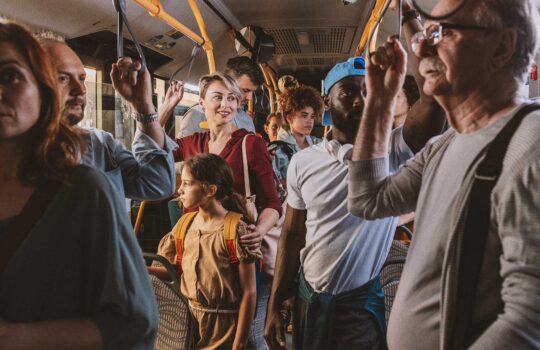
Public transport with kids sounds intimidating at first. There are the crowds, the tickets, the “what if we miss our stop?” panic, the “is that a pickpocket over there?” but it’s often the smartest, cheapest and most authentic way to get around. It gives families a chance to see the real rhythm of a city, not just its polished tourist layer. And when you get it right, it’s less chaos and more calm: affordable, predictable, and even a little bit fun.
Why public transport can be a parent’s best travel hack
Once you get past the learning curve and the spaghetti looking map of various transit lines, public transport becomes one of travel’s great parenting hacks. It’s cheaper than taxis, often faster than driving, and it frees you from parking headaches and car seat rules. More than that, it’s a way for kids to feel part of local life instead of spectators. Watching commuters, hearing station announcements, and counting stops turns into its own kind of adventure. You can’t go to London and not hear “Mind the Gap”.
It can also be one of the cheapest sightseeing tools you’ll ever use. Many cities have bus or tram lines that roll right past the major landmarks. Basically a built-in hop-on-hop-off tour for the cost of a single ticket. You can ride from one attraction to the next, rest tired feet, and still feel like you’re exploring.
And kids genuinely love it. Pressing the stop button, scanning a ticket, watching the doors open like magic. Or even better, watching daddy get in trouble for forgetting to validate his ticket. It gives them agency in a world that usually tells them to sit still and wait. Public transport offers motion, variety and people-watching. Three things children thrive on.
What to expect from buses, trains and subways
Every mode of public transport comes with its own personality, and knowing which one fits your day can make all the difference.
Buses and Trams are great for short city hops. They move slower than trains but make up for it with views. Perfect for spotting landmarks from street level. Drivers are usually happy to point out stops if you ask, and many modern buses now announce them in English too. Huzzah!
Trains are the best option for longer journeys. They’re roomier, often have bathrooms and snack carts, and let kids move around. Most European train systems offer child discounts or even free rides for under-sixes. Intercity trains double as quiet time. A chance to regroup, snack, or nap between adventures.
Subways and metros are fast, reliable, and a rite of passage in most major cities. They’re also sensory overload for little ones: loud, bright, and full of motion. Avoid rush hour if you can, stick to elevators for strollers, and teach older kids to stand behind the yellow line.
The trick is to treat each system like its own attraction. Kids may not remember every museum, but they’ll remember their first subway ride or the tram that clanged past a castle.
Kid safety and navigation
City systems move fast, and the first rule for parents is simple: slow down. Hold hands in crowded stations, board and exit together, and assign one adult to manage luggage while the other focuses on the kids.
Older kids can be assigned “jobs”. Put one in charge of pressing the stop button, another responsible for spotting the station name. It gives them purpose and keeps them engaged instead of restless.
If you’re separated, tell children to stay exactly where they are and approach a uniformed staff member. In big cities like Tokyo, Singapore or Berlin, help arrives fast, and staff are used to assisting families. For peace of mind, slip a contact card or wristband with your number into your child’s pocket before heading out.
Above all, don’t let safety worries scare you off. Millions of families use these systems daily. The key is to ride them like locals: alert, respectful, and with one eye on the exits.
Tickets, passes and timing
Nothing derails a morning faster than fumbling with ticket machines while the bus pulls away. The secret is to sort out your passes before you travel.
Most major cities sell day passes or family tickets that cover unlimited rides across buses, trams and metros. London’s Oyster card, Paris’s Navigo Easy, Singapore’s EZ-Link, and Berlin’s WelcomeCard all save time and money. They also eliminate the panic of missing a connection because you’re stuck at a kiosk.
Carry a bit of local currency because not all ticket machines accept foreign cards. In some places, tickets must be validated (stamped) before boarding. Missing that step can mean fines, even if you paid. But a good story to tell when you get back nonetheless.
And if your kids wake early, lean into it: early morning rides are calm, uncrowded and often cheaper. Under-sixes travel free in most European cities, and even older kids get steep discounts.
The best local bus lines for sightseeing
Skip the pricey tour buses because many cities have public routes that see the same landmarks for a fraction of the price. At the time of writing, these are some of the most scenic “local tours” in the world (so please double check before boarding) :
London – Bus 11
The original DIY sightseeing route. It runs from Liverpool Street to Victoria Station, passing St. Paul’s Cathedral, Trafalgar Square, Westminster Abbey and Big Ben. Grab a top-deck seat and it’s like your own budget tour bus.
Paris – Bus 72
This line follows the Seine from Hôtel de Ville to Parc de Saint-Cloud, passing the Louvre, Musée d’Orsay, Eiffel Tower and Trocadéro. The river views are unbeatable, and it’s easy to hop off for snacks along the way.
Rome – Bus 81
It threads through the city’s greatest hits. The Vatican, Piazza Venezia, Colosseum and Circus Maximus. Bonus: kids can say they saw Ancient Rome without setting foot in a tour group.
New York City – M5 or M20
The M5 runs along Fifth Avenue and Riverside Drive, passing landmarks like Rockefeller Centre, Times Square and the Empire State Building. The M20 winds through Battery Park and the World Trade Centre area with harbor views.
Singapore – Bus 36
Connects Changi Airport to the city centre via the East Coast Parkway. It’s air-conditioned, stroller-friendly, and glides past Marina Bay, Gardens by the Bay and Orchard Road. All for the price of a single fare.
Other honourable mentions: Lisbon’s Tram 28, a storybook ride through Alfama’s hills, and Hong Kong’s double-decker Tram 120, a moving window into everyday life in the city’s heart.
Best cities for public transport with families
Some places simply make it easy to get around with kids. Clean, punctual, safe and stroller-friendly. These cities turn public transport into a pleasure.
Tokyo, Japan: Ridiculously punctual, spotless and well-signed in English. Kids are treated kindly, and staff go out of their way to help lost travelers.
Singapore: Fully air-conditioned, accessible and safe. Elevators at every station, family restrooms and polite commuters make it ideal for families.
London, UK: The network reaches everywhere. Oyster cards and contactless payments simplify travel, and kids ride free on buses until age 11.
Berlin, Germany: The U-Bahn, S-Bahn and trams connect every neighborhood, and children under six travel free. Stations are stroller-friendly and trains rarely run late.
Seoul, South Korea: Immaculate subways with bright design, interactive maps and clearly marked family seating.
Zurich and Vienna: Both cities integrate trams, buses and trains seamlessly. Timetables are exact, and most rides feel more like gliding than commuting.
Best of the best:
Most scenic views: Hong Kong trams
Most punctual: Tokyo trains
Most stroller friendly: Singapore MRT
Best for budget travelers: Berlin and London
When to skip it
Public transport isn’t always the hero of the day. Skip it during rush hour, major festivals or in systems known for crowding or patchy service. If you’re lugging heavy suitcases or the kids are melting down, call a taxi and save the local experience for tomorrow.
Some cities just aren’t made for it. Naples’ buses, for example, have charm but little predictability. Manila’s jeepneys and Bangkok’s old buses are cultural icons but tough with toddlers and strollers. There’s no shame in choosing sanity over savings.
Knowing when to step back and say “not today” is part of traveling like a local too.
The local lane
What starts as logistics often becomes memory. The subway ride where your child made friends with another kid over snacks. The bus driver who waved at every stop. The feeling of being part of a city instead of watching it through a window.
Public transport is one of those underappreciated joys of family travel. Equal parts practical and poetic. It teaches flexibility, curiosity and confidence. It turns getting around into part of the story. And long after the souvenirs are gone, your kids might still remember the jingle of the tram bell, the whoosh of a train door, and the quiet pride of mastering a city’s maze all on their own.
Too Long? Here are the most common questions we’re asked.
Yes. Major city systems are well-regulated and secure. Keep kids close, travel off-peak, and use elevators for strollers when available.
In most countries, yes. Many offer free rides under a certain age and discounted passes for older kids.
Ask locals or check city tourism websites. Routes like London’s Bus 11 or Paris’s Bus 72 double as low-cost tours.
Tell kids to stay where they are and find a staff member. Most stations have help points or security staff ready to assist.
Tokyo, Singapore, London, Berlin, and Vienna consistently rank highest for safety, cleanliness and accessibility.