
When happy kids unlock a real holiday for everyone
Step onto almost any modern cruise ship and you’ll find the same scene: wide-eyed kids dragging their parents toward a splash zone, a playroom glowing with craft tables, or a teen lounge that looks more like a trendy coffee shop than a daycare. Parents, meanwhile, hover at the doorway with one question looping in their minds: Is this safe, and will my child actually enjoy it?
The answer, most of the time, is yes. Kids clubs on cruise ships are one of the most valuable (and underrated) parts of family cruising. They’re not just childcare, they’re hubs of play, learning, and socialising, run by trained staff who know how to keep children engaged in a safe environment. And when kids are happy, parents finally get what they’ve been craving: an actual holiday.
This guide will take you through exactly how kids clubs work, what to expect at every age, and how families can use them strategically to create more balance, joy, and breathing room on board.
What you’ll find in this guide:
What kids clubs actually are
Age groups, zones, and what happens inside
Safety, supervision, and sign-in rules
Nurseries and care for babies and toddlers
Food, allergies, and health policies
How to prep a child who is unsure
Making clubs work for parents’ sanity
Port day strategies and sea day rhythm
Teen spaces, freedom, and setting boundaries
What to pack and label for club days
Costs, reservations, and fine print
Kids clubs across all cruise lines
How to choose the right cruise line
The club is a tool, not a test
FAQ
What kids clubs actually are
Think of a kids club as part daycare, part summer camp, and part social hub but located on a ship where you’re never more than a short walk away. Cruise lines invest heavily in these spaces because they know family travel hinges on keeping kids happy. Rooms are bright, themed, and packed with toys, crafts, sports gear, and interactive screens. Some ships have climbing walls and science labs, while others run mock “Olympics” or stage performances that kids rehearse for during the week.
The daily schedule usually combines open play (kids choose what to do) with structured activities led by staff. Parents can pick up a printed program or check the app to see what’s on. Maybe slime-making at 10am, scavenger hunt at 2pm, pajama party at 7pm. Clubs are included in the cruise fare for most age groups, so you don’t pay extra except for nurseries or late-night sessions.
What parents often don’t realise until they use them: these clubs aren’t just keeping kids busy, they’re giving them a community. Children make cruise friends quickly, and for many, that becomes the highlight of the trip.
Age groups, zones, and what happens inside
Cruise lines divide clubs by age so that activities and supervision match developmental needs. The exact age brackets vary, but the structure looks something like this:
- Under 3s: Babies and toddlers usually have their own nursery with soft play mats, age-appropriate toys, and nap areas. Activities are shorter and calmer, and staff keep to parent instructions on feeding and changing.
- 3–5 years: This is the high-energy, make-friends-fast group. Expect crafts, dress-up, sing-alongs, and games that switch every 20 minutes to keep attention spans in check. Staff encourage teamwork and gentle routines.
- 6–8 years: The “big kid” group thrives on scavenger hunts, beginner science projects, dance-offs, and team games. They start to build real friendships here.
- 9–11 years: These kids want more independence. They’ll do trivia, sport tournaments, and creative projects, and many clubs let parents decide if they can self-sign out.
- 12–14 years (tweens): Think youth club vibes. Console gaming, karaoke, movie nights, and staff who are more like camp counsellors than babysitters.
- 15–17 years (teens): Dedicated lounges with later hours, mocktail bars, and low-key social events. Staff facilitate, but teens are given freedom to make the space their own.
The point isn’t just age separation, it’s tailored experiences. A five-year-old and a fifteen-year-old don’t want the same thing, and cruise lines have learned that well.
Safety, supervision, and sign-in rules
Safety is always the number one concern for parents, and rightly so. Kids clubs have strict sign-in and sign-out systems. When you register your child on embarkation day, staff collect your details, approved pickup list, allergies, and emergency contacts. At pickup, they check photo ID or require a password before releasing your child.
Staff-to-child ratios vary, but they’re usually comparable to nurseries or day camps on land. Clubs also have strict headcount rules. If too many kids show up, staff will close entry to maintain ratios. Hallways are locked or gated, and bathroom breaks are logged.
Emergency drills include kids clubs too. In the unlikely event of an emergency, children are escorted to family muster stations where they wait with staff until parents arrive. That reassurance is huge for families.
Nurseries and care for babies and toddlers
Not every ship has a nursery, so if you’re cruising with a baby, research carefully. Where nurseries are offered, they usually take infants as young as six months and toddlers up to age three. Spaces are small, with age-appropriate toys, mats, and cribs in a separate nap room.
Sessions must be booked in advance, often with time limits per family to keep things fair. Parents can leave instructions for feeding, naps, and comfort routines. Staff record what happens in each session so you know how your child did.
Nurseries almost always cost extra (hourly fees), but many parents say it’s worth every cent for the ability to enjoy a proper meal or show. Just note that nursery slots fill quickly. Book the moment reservations open.
Food, allergies, and health policies
Most clubs don’t serve full meals during the day, but they might offer snacks or run group dinners for kids. Parents are asked to declare allergies during registration. Many ships run nut-free policies in clubs, and staff are trained in handling epi-pens and inhalers. If your child has severe allergies, you’ll want to clarify whether staff keep medication at the desk or require parents to supply a kit.
Illness rules are strict: no fever, vomiting, or obvious infections allowed. It may feel harsh if your child has a mild bug, but in a closed environment like a ship, one sick child can quickly lead to dozens. Expect lots of hand sanitiser stations, toy cleaning rotations, and supervised hand washing before snacks.
How to prep a child who is unsure
Not every child runs into a new club without hesitation. Some cling, some cry, and some outright refuse. The best tactic is gradual exposure. Visit during open house hours when parents are welcome. Play with your child in the space so it feels familiar. Introduce them to one staff member by name and agree on a short “test session.”
Set realistic expectations: maybe 30 minutes the first day, an hour the next. Always return when you say you will. This builds trust that you’ll come back. Pack a comfort item. A small toy, a blanket square, and let staff know how your child likes to be comforted.
Parents often report that by day two or three, reluctant kids don’t want to leave. Sometimes it’s just about giving them time to see other children having fun without pressure.
Making clubs work for parents’ sanity
Kids clubs aren’t just a benefit for children, they’re survival tools for parents. Imagine sitting through a meal without cutting food into tiny bites, or watching a show without whispering “shh” every two minutes. That’s what the club buys you.
The best strategy is balance. Use clubs for blocks of time that give you genuine rest. A nap, a spa appointment, a quiet coffee, or simply staring at the sea without interruptions. Don’t feel guilty. Your kids are probably having more fun than you are.
Set family “anchors”. Maybe breakfast together, then club time, then regroup for lunch. That way kids know when they’ll see you, and you know you’ll get pockets of calm built into the day.
Grandparents can also be involved. Many families let them handle drop-off or pickup, which makes them part of the routine without overexerting them.
Port day strategies and sea day rhythm
On port days, parents often wonder whether to bring kids ashore or use the club. The answer is both, depending on energy levels. Some families split: one parent takes the older kids snorkeling while the younger stays happily in the nursery. Others let grandparents do a short excursion with the children while parents enjoy time ashore alone.
Sea days are when clubs really shine. Programs are packed with special events like talent shows, science experiments, or ship-wide scavenger hunts. Families who plan ahead by circling two or three sessions they don’t want to miss usually get the most out of it.
The trick is rhythm. Don’t overschedule. A morning in the pool, an afternoon in the club, quiet time after lunch, then a family dinner makes for a day that flows without meltdowns.
Teen spaces, freedom, and setting boundaries
Teen clubs are going to be the hardest sell. Teenagers don’t want to be “babysat.” But the good clubs are more like youth centres, with gaming consoles, music, mocktail bars, and staff who act more like cool camp leaders than supervisors.
Day-one mixers are critical. Encourage your teen to attend, even reluctantly, hell, bribe them if you have to. Because once they meet one or two peers, the rest of the week transforms. Suddenly, they’re roaming the ship with friends, hitting movie nights, and disappearing into the lounge for hours in a safe, contained space.
Set clear boundaries ahead of time. Decide how late they can stay, whether they can self-sign out, and how often they should check in with you. Use the ship’s messaging app if available, but don’t overdo it. Constant texts defeat the independence they crave.
For shy or neurodiverse teens, ask staff if they can arrange a quieter introduction before the group meets. A little extra sensitivity goes a long way.
What to pack and label for club days
A small drawstring bag is perfect for club days. Pack:
- Socks (many clubs require them for indoor play areas)
- Swimsuit and rash guard for water play
- Closed-toe shoes for sports
- A jumper for chilly air-conditioned rooms
- A labelled water bottle
- Any comfort item or medication approved by staff
Label everything. Lost goggles and hoodies are the number one frustration parents report. Teach kids to hang their bag on the same hook each day. That small habit saves time and arguments.
Costs, reservations, and fine print
Most kids clubs are included in the cruise fare, but there are exceptions. Nurseries almost always cost extra, charged hourly. Late-night group babysitting (usually after 10 or 11pm) also comes with a fee. Some special activities like behind-the-scenes tours or science workshops may require sign-up.
Reservations for nurseries and certain sessions often open on embarkation day and fill quickly. Families who plan ahead and book early get the best slots. Also note: if you’re late for pickup, there can be fines. Rules vary by line, but they’re strictly enforced to keep staff schedules fair.
It may feel like a lot of rules, but in reality they keep everything running smoothly. Thousands of children use these programs every year, and the fine print is what prevents chaos.
Kids clubs across major cruise lines
Every cruise line with families in mind runs a kids program, but they vary in name, age brackets, and vibe. Knowing the differences helps you match your child’s personality (and your sanity needs) with the right ship.

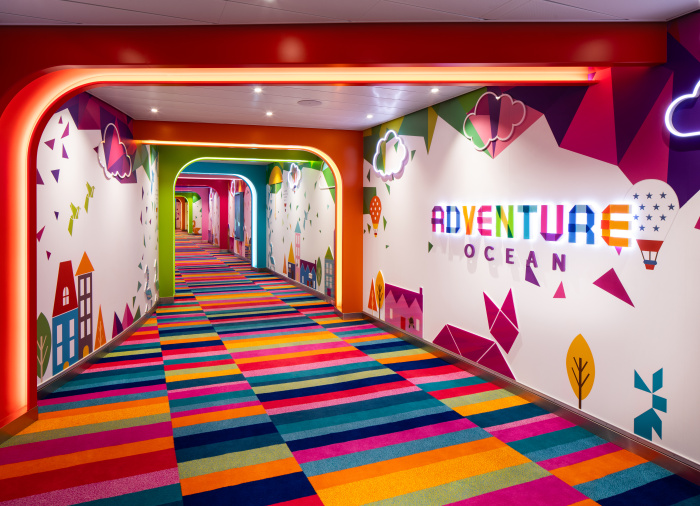
Royal Caribbean: Adventure Ocean
- Age groups: 6 months to 17 years. Nurseries cover babies, then clubs are split into Aquanauts (3–5), Explorers (6–8), Voyagers (9–11), plus teen lounges.
- Highlights: Science labs, art programs, ship-wide scavenger hunts, and large, well-equipped spaces. Teens get private lounges with DJs and game consoles.
- Best for: Families with kids of all ages, especially school-age children who thrive on structured, high-energy programming.

Disney Cruise Line: Oceaneer Club & Lab
- Age groups: 6 months to 17 years. Nurseries serve babies, Oceaneer Club and Lab welcome ages 3–12, with separate Edge (11–14) and Vibe (14–17) lounges.
- Highlights: Immersive Disney themes — Marvel training, Star Wars playrooms, Toy Story dress-up. Staff run story-based activities.
- Best for: Families with younger kids who love characters, or tweens/teens who still enjoy Disney’s magic woven into every activity.

Norwegian Cruise Line:
Splash Academy & Entourage
- Age groups: Splash Academy covers 6 months to 12 years, split by age; Entourage is the teen lounge for 13–17.
- Highlights: Circus workshops, sports competitions, themed parties. Entourage has a nightclub vibe without alcohol.
- Best for: Families with energetic kids who love physical play and teens who want independence without being bored.

MSC Cruises: Doremi Clubs
- Age groups: Baby Club (under 3), Mini Club (3–6), Junior Club (7–11), Young Club (12–14), Teen Club (15–17).
- Highlights: Partnerships with LEGO and Chicco mean high-quality play spaces. Teens enjoy virtual reality, gaming tournaments, and music sessions.
- Best for: European families or those wanting a multicultural vibe, with programs running in multiple languages.

Carnival Cruise Line: Camp Ocean
- Age groups: Penguins (2–5), Stingrays (6–8), Sharks (9–11). Circle C (12–14) and Club O2 (15–17) serve teens.
- Highlights: Ocean-themed crafts and science, group games, and lively staff. Teen spaces feel like youth clubs with dance floors and movie nights.
- Best for: Outgoing kids who like lots of group energy and a party-like atmosphere.

Princess Cruises: Camp Discovery
- Age groups: Divided into The Treehouse (3–7), The Lodge (8–12), and The Beach House (13–17).
- Highlights: Nature and science themes, discovery labs, and partnerships with Discovery Channel. Teens get hangout lounges and movie nights.
- Best for: Families who want a calmer vibe with a focus on learning and enrichment rather than nonstop noise.

Celebrity Cruises: Camp at Sea
- Age groups: Divided into The Treehouse (3–7), The Lodge (8–12), and The Beach House (13–17).
- Highlights: Nature and science themes, discovery labs, and partnerships with Discovery Channel. Teens get hangout lounges and movie nights.
- Best for: Families who want a calmer vibe with a focus on learning and enrichment rather than nonstop noise.
Quick Comparison: Kids Clubs by Cruise Line
| Cruise Line | Program | Age Groups | Highlights | Best For: |
| Royal Caribbean | Adventure Ocean, Teen Lounge | 6 months – 17 years Nursery, 3–5, 6–8, 9–11, Teens | Science labs, scavenger hunts, large play areas, DJ teen lounges | Families with kids of all ages; especially great for school-age children |
| Disney | Oceaneer Club & Lab, Edge, Vibe | 6 months – 17 years Nursery 3–12 11–14 14–17 | Immersive Disney themes, Marvel/Star Wars playrooms, character-led activities | Younger kids who love Disney; tweens who enjoy story-driven play |
| Norwegian (NCL) | Splash Academy, Entourage | 6 months – 17 years Nursery 3–12 Teens | Circus skills, sports comps, nightclub-style teen space | Energetic kids and teens who want independence |
| MSC Cruises | Doremi Clubs | Nursery 3–6 7–11 12–14 15–17 | LEGO & Chicco playrooms, VR, gaming tournaments, multilingual staff | Families who want a multicultural vibe with creative play |
| Carnival | Camp Ocean, Circle C, Club O2 | 2 – 17 years 2–5 6–8 9–11 12–14 15–17 | Ocean-themed crafts, lively group games, party-style teen clubs | Outgoing kids who thrive on high-energy fun |
| Princess Cruises | Camp Discovery | 3 – 17 years 3–7 8–12 13–17 | Nature & science themes, Discovery Channel partnership, enrichment activities | Families preferring calmer, learning-focused programs |
| Celebrity Cruises | Camp at Sea | 3 – 17 years (flexible groupings) | STEM projects, art workshops, Xbox stations, cultural programs | Older kids and families who value creativity and education |
How to choose the right kids club for your family
The truth is, no single cruise line wins for every family — it depends on your kids’ ages, personalities, and what you need from the trip.
- For babies and toddlers: Look to lines with strong nurseries like Royal Caribbean, Disney, or MSC. Not every line accepts under-threes, so check before you book.
- For preschoolers: Disney shines here, with immersive playrooms and characters woven into every activity. Carnival’s Camp Ocean also keeps this age group buzzing with crafts and group games.
- For school-age kids: Royal Caribbean’s Adventure Ocean and Carnival’s Camp Ocean are the crowd favourites. Structured activities, sports, and scavenger hunts keep energy levels high without feeling like school.
- For tweens and teens: If your child is craving independence, Norwegian’s Entourage and Carnival’s teen clubs lean into that social, high-energy vibe. For something calmer, Princess and Celebrity offer lounges that feel more like hangouts than youth centres.
- For families who want education built in: Princess (Camp Discovery) and Celebrity (Camp at Sea) fold science, culture, and creativity into the programming, so the club feels less like childcare and more like enrichment.
- For multicultural exposure: MSC Cruises is a standout, with multilingual staff and programs that reflect the diversity of families sailing from Europe.
If you’ve got a mix of ages, go for a line with the widest spread — Royal Caribbean or Disney cover babies right up through late teens. If you only have older kids, you might prioritise teen lounges and freedom over nurseries.
At the end of the day, the best choice is the one where your kids feel excited to walk through the club doors. Because when they’re happy, you’re free to finally enjoy that quiet coffee, uninterrupted swim, or a long dinner that doesn’t end with someone crawling under the table.
The club is a tool, not a test
Parents sometimes hesitate to use kids clubs, worrying it means they’re not spending enough family time together. The truth is the opposite. By giving your kids space to play, you’re making family time less stressful and more joyful. Children return from clubs with stories to share, energy burned off, and new friendships. Parents and grandparents get the breaks they need to stay patient and present.
If your child spends half the cruise in the club, wonderful. If they only want an hour a day, that’s fine too. The club isn’t a test of parenting, it’s a tool. Used well, it’s the difference between coming home frazzled and coming home refreshed, with memories everyone treasures.
Too Long? Here are the most common questions we’re asked.
Clubs usually start at age three for the main program, with nurseries for younger babies and toddlers. Teen spaces often go up to age 17.
Only if you allow it, and usually from age 9–11 upwards. Otherwise, they’ll stay until an approved adult collects them.
Yes, but you must declare them clearly. Staff are trained, but parents should also provide written instructions and emergency meds like epi-pens.
Daytime clubs are included. Nurseries, late-night care, and some premium workshops may cost extra.
Start small, attend open house together, and give it time. Many children warm up after a session or two once they see other kids having fun.