First Flight Fears: Helping Kids Cope with Air Travel
Jump to Section:
What They Never Warn You About
Understanding Kids’ Fears
Preparing Before The Flight
Comfort and Reassurance
Distraction as a Coping Mechanism
Turbulence and Takeoffs
When Fear Overwhelms
It Gets Easier
FAQs
The fear factor no one warns you about
Packing for a family trip is stressful enough. But for many parents, the real challenge comes once you’re on the plane and your child suddenly panics. The loud engines, the strange seatbelt rules, the new smells and sounds. It’s overwhelming. First-flight fears can turn an exciting adventure into a panic attack or meltdown before you even leave the runway.
If you’ve ever worried about your child screaming through takeoff or refusing to get on the plane, you’re not alone. Parents talk about it constantly in travel forums and Facebook groups: “My toddler screamed the entire ascent,” or “My seven-year-old was convinced turbulence meant we were crashing.” The good news is that kids’ fears are normal and with preparation, reassurance, and a few clever tools, most families find that flying gets easier each time.
Understanding kids’ fears
Children fear different aspects of flying depending on their age and temperament. For some, it’s simply the fear of the unknown. They’ve never been on a plane and don’t know what to expect. Others are thrown off by sensory overload: the roar of engines, safety announcements, crowded boarding lines. For many, the hardest part is loss of control. Being strapped in with no option to move freely.
It’s also worth remembering that kids often mirror their parents’ stress. If you’re anxious about flying, they’ll pick up on that tension. Keeping yourself calm and matter-of-fact goes a long way in setting the tone for them.
Preparing before the flight
The most effective way to ease first-flight fears starts long before you get to the airport. Kids cope better with what they understand, so start introducing the idea of flying early.
- Talk about it in simple terms. Explain that planes are just another way to get from one place to another, like cars or trains, only faster. Picture books about airplanes can help — they show kids the steps of boarding, buckling up, and flying through the clouds.
- Watch videos together. YouTube has countless “kids’ first flight” clips and airline safety videos. Seeing what a plane looks like inside helps demystify the experience.
- Play pretend. Set up “airplane practice” at home: line up chairs, buckle stuffed animals in, and play a takeoff soundtrack. When kids role-play the experience, it feels less intimidating.
- Visit an airport viewing deck. If you live near one, let your child watch planes take off and land. Seeing them in action makes it less abstract.
- Let kids pack their own bag. Even if it’s just a small backpack with a toy and snack, giving them a sense of ownership helps them feel prepared.
? For more on how to organize kids’ bags so they can grab their own gear, see Organizing Packing Cubes for Kids’ Gear.
Comfort and reassurance on board
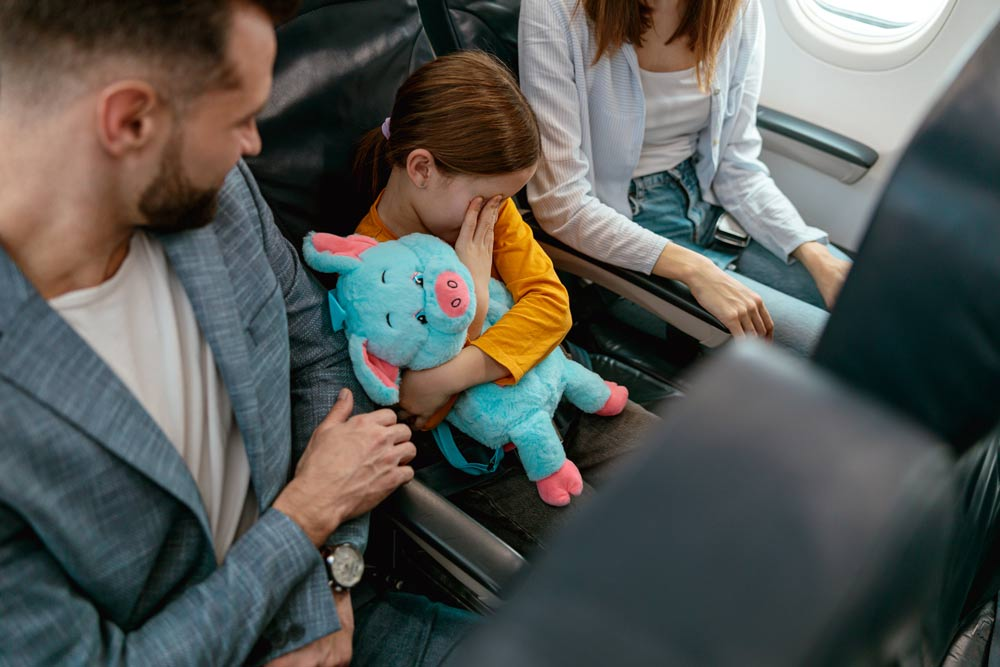
Once you’re on the plane, comfort is your best ally. A child with a blanket, pacifier, or favorite stuffed animal is much more likely to settle than one without familiar anchors. These small items carry a sense of safety that no in-flight entertainment can replace. Smells can also be surprisingly triggering. Airplane cabins have their own “scent”. Recycled air, food carts, cleaning supplies. Kids notice these changes, and they can feel unsettling. Bringing a familiar-smelling cloth or blanket can be grounding, especially for toddlers.
Then there’s the bathroom. Airplane toilets are intimidating even for adults, and for kids they can be downright terrifying. The door is weird, the space is tiny, and the flush is shockingly loud. Our daughter was petrified the first time. She thought the noise might swallow her. What helped was reframing it as something silly and fun. I told her, “I’m going to go pee on some clouds, want to help me make some clouds yellow?” Suddenly it wasn’t a monster toilet; it was part of the adventure. Many parents find that turning fear into play, counting down before pressing the flush button, or pretending the sound is a rocket blasting off can transform dread into giggles.
Snacks are another form of comfort. A familiar granola bar or fruit pouch can be grounding when everything else feels strange. Parents often say that keeping a rotation of favorite snacks is as much about calming nerves as filling stomachs. Anything familiar when in an unfamiliar setting helps. Even if it is only a granola bar to you, it’s reassurance to them. Try not to forget that.
Noise-canceling or volume-limiting headphones also make a huge difference. The roar of engines during takeoff can feel frightening, but a pair of headphones playing soft music, a familiar audiobook, or even a favorite show helps drown out the stress.
? We’ve rounded up the best options by age in our Best Kids’ Headphones for Travel guide.
? For sanity-saving snack ideas, check Snacks that Save Sanity on Flights.
Distraction as a coping tool
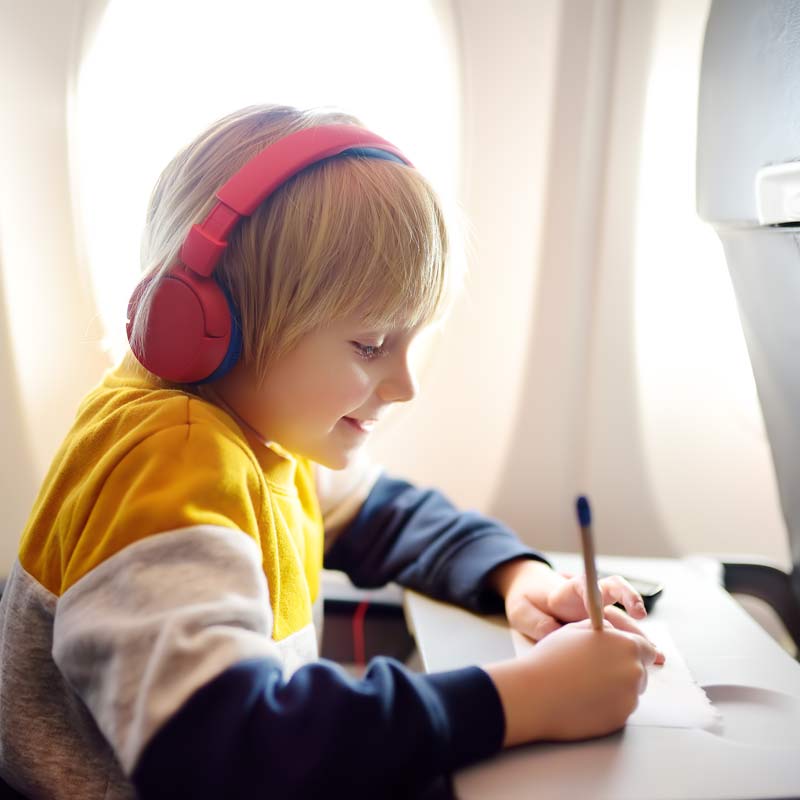
Distraction isn’t just about throwing toys at the problem, it’s about using the right kind of engagement at the right time. Nervous kids need activities that absorb their attention enough to override the cycle of dread and worry.
For younger children, tactile activities work best: reusable sticker books, magnetic drawing pads, or small packs of LEGO bricks they can build and rebuild. Older kids respond better to storytelling. Downloaded audiobooks, podcasts, or even simple card games that get them talking and laughing.
Another underused tactic is involvement. Kids often calm down when they’re given a “job” to do. Let them be in charge of handing out snacks, choosing which coloring page to start with, or holding the boarding passes. Ok maybe not that. But the act of being useful distracts from fear and gives them a sense of control.
Digital distractions have their place too, especially on long flights. But instead of handing over the tablet as a last resort, try structuring it into the rotation. Parents who save the “big guns”, a favorite movie, a new downloaded app for the middle of the flight often report smoother journeys. It breaks the trip into chunks: first a toy, then a snack, then a show. That sense of progression keeps kids from spiraling into “are we there yet?” mode.
Turbulence, takeoff, and other stress points
Takeoff and turbulence are the two moments most likely to trigger fear. At takeoff, prepare kids in advance: the engines will roar, the plane will tilt, and it might feel like a rollercoaster. Framing it as an exciting ride like “we’re blasting off like a rocket” helps some kids, while others do better with quiet reassurance and a hand to hold. Drinking from a straw cup, sucking a pacifier, or chewing gum also distracts them while helping with ear pressure. Personally I’ve distracted my daughter by teller her I’ll give her €5 if she can spot our house on take-off. There was no way she would ever spot it, but the sheer focus made her completely forget we were thousands of feet in the air in a metal tube. Sure she never spotted it, but she doesn’t know that. I might be out €5 but I feel like I saved a fortune mentally.
Turbulence is trickier because it catches kids off guard. Simply telling them “don’t worry” often backfires; their bodies are telling them something is wrong. Parents who’ve been through it recommend turning turbulence into a game or a metaphor. Some call it “bumpy clouds,” others pretend the plane is “dancing in the sky.” Counting the bumps out loud can also shift the focus from fear to curiosity. Here’s another chance to make a game. I like to play “will the plane go up or down next?”. It shows that I have absolutely no fear, and it makes us BOTH look forward to the next bump.
For slightly older children, teaching a calm breathing trick can work wonders. Try “smell the flower, blow the candle”: breathe in through the nose as if sniffing a flower, then blow out gently like you’re blowing out a candle. Doing it together makes it feel less like a chore and more like teamwork.
Psychologists also suggest reframing turbulence as “the plane adjusting itself.” A steady, lighthearted explanation from you “the pilots are steering us to smoother air” reassures kids that adults are in control. The calmer and more casual you sound, the more likely your child is to follow your lead. My daughter is a bit of a science nerd. So I prepped her a few days in advance by showing her youtube videos about the scientific reasons for turbulence. The little nerd was explaining turbulence to my wife like she was Bill Nye.
When fears overwhelm
Despite all your preparations, some kids will still struggle. And let’s be crystal clear… That’s completely normal. Honestly I’ve been through some turbulence where a little bit of pee has escaped. The key is to validate their feelings without letting fear take over the whole cabin. Instead of dismissing (“Don’t be silly, it’s fine”), try empathy: “I know this feels scary, but we’re safe. I’m right here with you.”
Sometimes, a short walk up and down the aisle resets the mood. For older kids, simple breathing exercises or “counting the bumps” during turbulence can turn fear into a game. For younger ones, eye contact, hand-holding, and familiar music often work wonders. The important thing to remember is that kids rarely melt down for the entire flight.
Flying gets easier with practice
First-flight fears are normal. Kids are stepping into an entirely new environment full of sights and sounds they don’t understand. But with preparation, comfort, and reassurance, the majority of children adapt quickly and many even start to enjoy flying after the first or second experience.
The trick is to plan ahead, pack smart, and keep perspective. Every parent has been there: the screaming toddler at takeoff, the anxious seven-year-old gripping the armrest. It feels stressful in the moment, but it’s survivable. And each flight gets easier. Flying with kids isn’t about eliminating fear it’s about giving them the tools to cope, and showing them that travel can be safe, exciting, and even fun.
Too Long? Here are the most common questions we’re asked.
Start by preparing them in advance with books, videos, and play-acting. On the plane, use comfort items, snacks, and distractions to ease nerves.
Yes, many are. Explain it simply (“the plane is bumping on clouds”), use metaphors, and offer calming tools like breathing exercises or counting games
Role-play airplane routines at home, watch videos of planes, and let them pack a small bag with their own toy or snack.
Pacifiers, blankets, stuffed animals, and kid-friendly headphones all help children feel secure on board.
Yes. Most children’s fears decrease with experience, especially if parents stay calm and supportive.