How to Survive a Long-Haul Flight with a Toddler in Their Own Seat
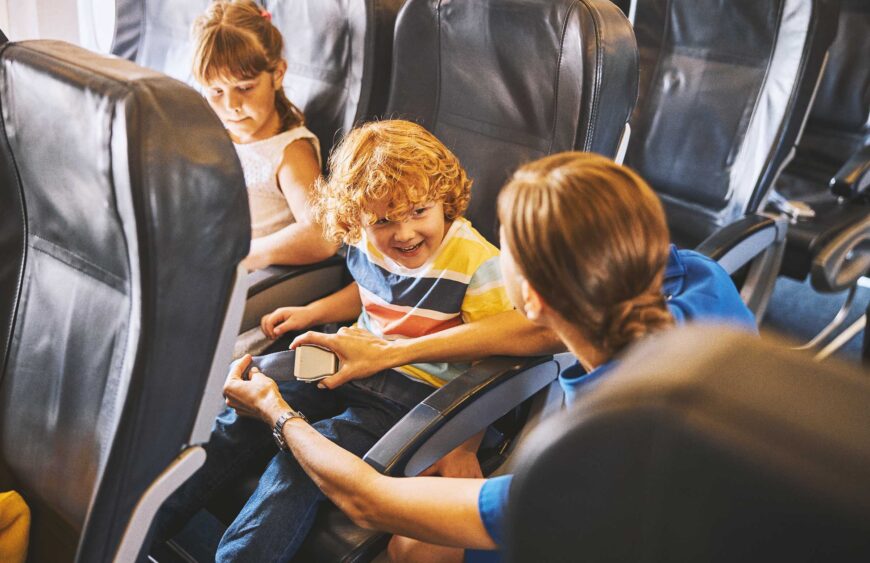
You paid for the seat. Your toddler is strapped in. You’ve got six hours ahead of you and the confidence of someone who has absolutely no idea what’s about to happen.
Buying your toddler their own seat is the right call for a long-haul flight. It’s safer, it’s more comfortable for everyone, and it gives you somewhere to put a car seat if you’ve brought one. What nobody really tells you is that the seat itself is only the beginning. The part that matters is what you do with it for the next several hours while your child decides the tray table is a drum kit.
This isn’t a packing list. It’s a field guide built from the questions our community keeps asking: what to do about the kicking, how to get a toddler to sleep in an upright seat, whether those busy books are actually worth it, and how to manage all of this when you’re on your own. The answers exist. They come from parents who’ve done it, not from a PR team.
Why a seat of their own isn't the easy part
Most of the stress that comes with a lap infant comes from the physical constraint. There’s nowhere to set them down, nowhere to rest your own arms, and if they fall asleep on you, you don’t move for three hours. So parents reasonably assume that a toddler in their own seat will be easier.
It is, in several ways. You have your body back. The car seat gives you a sleep surface. You’re no longer the entire support system for another human’s skeleton for the duration of a transatlantic flight.
What you’re trading for is autonomy. A lap infant can’t go anywhere. A toddler in their own seat absolutely can, and will, and wants to. They’ll try to climb over you, reach the people in front, slide under the belt, and conduct what can only be described as a structural integrity test on the seat pocket. The seat is a resource. How you use it determines everything else.
If you’re still weighing up whether to buy a seat at all, here’s an honest breakdown of lap infant vs buying a seat that covers the cost, the comfort, and what parents actually think after doing it both ways.
Foot hammocks: the single biggest comfort upgrade
One of the most consistent recommendations in our community threads is the foot hammock, sometimes called a foot ledge or leg rest. The concept is simple: it’s a strap that clips to the tray table on the seat in front and suspends from it, creating a platform that supports a toddler’s dangling legs.
Why does this matter? A toddler’s legs don’t reach the floor. They hang. And dangling legs are uncomfortable legs, which become restless legs, which become kicking legs, which become the thing the parent two rows ahead tweets about. The foot hammock solves this by giving small legs somewhere to be. It doesn’t eliminate movement, but it reduces the aimless kicking that comes from sheer physical discomfort rather than from toddler chaos specifically.
The most widely recommended options in the community are the Flyaway Kids Foot Rest and the BedBox, both of which pack flat and weigh almost nothing. Before you buy one, check your airline’s policy. Some carriers are fine with them. Others consider them a safety hazard during turbulence or takeoff and landing. The rule of thumb is that it needs to be fully removable and stowed during those phases, which most hammock designs accommodate. Call ahead if you’re not sure, or check the airline’s carry-on policy page directly, because crew at the gate and crew on board sometimes have different answers and you want the right one before you’re at 35,000 feet.
Window seat positioning helps here too. If your toddler is at the window, there’s a wall on one side and you on the other, which limits the radius of chaos considerably. For seat selection strategy on long-haul with a toddler, this piece on which seats to actually book covers the window vs. middle vs. aisle trade-offs in detail.
Car seat positioning for sleep
If you’ve brought a car seat onto the plane, which is worth doing on long-haul flights because it gives a toddler a familiar, enclosed sleep surface they already associate with being still, then installation angle matters more than most guides acknowledge.
Aircraft seats recline slightly, but not enough to give a car seat the angle it needs for a toddler to sleep comfortably with their head supported. The fix that comes up repeatedly from parents who’ve cracked this is a rolled blanket or a small pool noodle placed under the car seat’s base at the front edge. This tilts the seat back a few degrees, which is enough to stop the chin-to-chest slump that wakes a sleeping toddler and everyone around them.
The tighter you can wedge the car seat against the aircraft seat back, the more stable it will be. A loose car seat rocks with the plane and that movement is enough to break light sleep. Most aircraft tray tables can’t bear weight but the seatbelt does route through the car seat in the standard way, and a snug belt makes a real difference.
One thing to check before you fly: not every car seat is approved for aircraft use. In Europe, the relevant certification is ECE R44 or ECE R129 (i-Size). In the US, the FAA approves specific models and requires the label to say so. If your seat isn’t approved, the crew can ask you to gate-check it, which defeats the point. The airline’s website will list what they accept, and it’s worth confirming before you pack it.
Getting a toddler to sleep in any seat on a long-haul flight involves more than just the hardware, of course. This piece on sleeping on planes with kids covers the timing and environment side of things if you want the fuller picture.
How to pace activities so they actually work
The instinct is to open everything immediately. You’ve packed the bag, you’ve bought the sticker books and the new crayons and the small figurines wrapped individually in tissue paper, and the moment your toddler shows any sign of boredom you hand it all over at once. By hour two, you’re out of material.
Activity pacing is the discipline of introducing things in sequence and holding things back deliberately. The model that works on long flights is roughly this: start with familiar, move to new, finish with familiar again. Not because toddlers are predictable, but because familiar things require less energy to engage with and are therefore useful when your child is overtired, overwhelmed, or close to the edge.
The first hour after takeoff is often the most manageable because everything is still novel. The window is interesting. The tray table is interesting. The seatbelt is interesting. Use this time without reaching into the bag at all if you can. Save your material for the middle stretch, which is when toddler engagement typically collapses. That’s when you bring out the new sticker book, the playdough, the small world figures.
New toys are not automatically better than familiar ones. A toy your toddler knows how to use independently is worth three toys that require your constant facilitation. The community consistently comes back to this: whatever you pack, make sure some of it works without you. You need periods where your toddler is occupied and you are not simultaneously a play partner.
For specific toy recommendations that hold up on long flights, this guide to the best plane toys for kids is worth reading before you pack.
The busy book question, answered honestly
Busy books come up in the community regularly and the answer is usually the same: they work for some toddlers and not others, and the variable is almost entirely whether the child has used one before.
A busy book that a toddler encounters for the first time at cruising altitude is a gamble. Some children are immediately absorbed by the zips and buttons and velcro. Others look at it for thirty seconds, hand it back, and go back to trying to remove the seat pocket contents. You cannot know which category your child is in until you’ve tried it at home, which is the only useful piece of advice here: test it before you pack it. If they engage with it for more than ten minutes at home, it’ll travel well. If they don’t, leave it.
The thread in our community asking whether busy books are worth buying for a 15-month-old got honest answers: at that age, the fine motor demands of many busy book activities are often too high, which means the child gets frustrated rather than engaged. At 18 months to two years, the range starts to expand. By two and a half, a child who’s used one before can genuinely self-occupy with a good busy book for stretches of fifteen to twenty minutes, which on a long-haul flight feels like a genuine gift.
If you’re considering buying one specifically for a flight, buy it a month before you travel and let it become familiar at home. Then pack it as something they know, not something new.
Flying solo with a toddler in their own seat
Flying alone with a toddler in their own seat is meaningfully different from flying with a partner, and it deserves its own section rather than being folded into general advice.
The core logistical problem is that you now have two seats to manage, two sets of needs to track, and both hands occupied at any given moment. The things that a second adult handles almost without thinking, like keeping an eye on the bag while you take a toddler to the bathroom, or holding a snack while you locate the wipes, become genuinely complicated.
The best single piece of equipment for solo flying with a toddler is a small cross-body bag or a zipped waist pack worn on your body throughout the flight. Not a nappy bag. Not a tote. Something you can reach into with one hand while the other hand is holding a wrist. The cross-body bag stays on you when you stand up, which means you’re not leaving things on the seat unattended, and it puts the things you need most often, snacks, wipes, the pacifier, a spare dummy, within reach without a rummage.
Aisle seat makes more sense for solo flying than window, counterintuitively. Yes, the window offers a containment advantage, but you need to be able to get out of that row without climbing over your toddler or disturbing neighbours, and you need to be able to see the aisle. The aisle gives you access and sightlines.
Pre-boarding diaper change is non-negotiable. Change at the gate, not on the plane, because the aircraft changing table requires both hands, a folded space barely wider than a piece of A4 paper, and confident balance in a moving environment. The gate has a flat surface, decent light, and doesn’t involve a queue of people waiting for the toilet behind you. Change at the gate.
For a deeper look at the solo flying situation with all ages, this survival guide for flying solo with kids covers everything from check-in to touchdown.
Ear pressure on descent
Toddlers can’t do the deliberate jaw movements that adults use to equalise ear pressure, and they can’t tell you clearly that their ears are hurting. What you get instead is a child who was fine twenty minutes ago and is now screaming in a way that doesn’t respond to anything you try.
The swallow reflex is the most reliable equalisation trigger for this age group. For a toddler who drinks from a cup or a sippy cup, timing a drink to coincide with descent is the most practical approach. Start offering it when the seatbelt sign comes on for landing, which typically gives you a fifteen to twenty minute window before the pressure change becomes acute. Continuous swallowing is more effective than a single gulp, so small sips repeated over several minutes rather than one large drink.
Breastfeeding or bottle feeding works on the same principle, and if your child still feeds, descent is a good time to use that. Some parents use a pacifier for the same reason.
Ear putty, sometimes marketed as filtered earplugs for children, is worth knowing about. It doesn’t eliminate the pressure change but it slows the rate of pressure change that the eardrum has to respond to, which reduces the discomfort. The brand EarPlanes makes a children’s version. You put it in at the start of descent, not when the ears are already hurting, because by then it’s too late.
If your child has a cold or any congestion before you fly, the risk of significant ear pain on descent goes up considerably because the eustachian tubes don’t drain as effectively. A children’s decongestant given 30 minutes before descent can help, but talk to your GP before the trip about what’s appropriate for your child’s age and weight.
More on managing ear pressure, including what to do when nothing works, is in this guide to easing toddler ear pain on planes.
Structuring the flight in chunks
The most exhausting thing about a long-haul flight with a toddler isn’t any single moment. It’s the relentlessness of it. When you think about eight hours as eight hours, the weight of it is crushing. When you break it into chunks with a plan for each one, it becomes something you can manage.
A structure that parents in the community come back to is three to four blocks, defined by toddler energy and sleep cycles rather than the clock. The first block is the active phase: the post-takeoff novelty window where the child is alert and interested. Use this for low-effort engagement, looking out the window, exploring the seat, a familiar snack. Don’t reach for the activities yet.
The second block is the main activity phase, usually somewhere between hour two and hour four depending on the flight time and the child. This is when you bring out the new material. Rotate activities every fifteen to twenty minutes rather than letting one thing drag to the point of frustration.
The sleep block is the prize. If you’ve timed the flight well, this overlaps with your child’s normal sleep window. A car seat helps here because it signals something familiar. Keep the cabin environment as sleep-conducive as you can: window shade down, a familiar blanket, white noise through a small portable speaker or headphones if your toddler uses them.
The fourth block, if you need it, is the final stretch after sleep: more snacks, a screen if that’s something you use, the last activity from the bag. The goal is arrival, not perfection.
Snacks deserve their own strategy too, and airport prep before you even board can take significant stress out of the day before the flight even begins.
Long-haul with a toddler in their own seat is not easy. It’s also not as bad as it looks from the outside, especially once you’ve got a structure to work with and you know which problems are solvable. The foot hammock is solvable. The ear pressure is solvable. The activities are solvable. The rest is just the usual chaos of being the parent of a small person, temporarily at altitude.
You’ve got this. Probably.