A cruise looks like the easiest family holiday on paper. One bag. One ship. Everything in one place. And for a lot of families, it genuinely is, once they know the terrain. But cruising with kids has a safety landscape that’s different from any other kind of family travel, and most of it doesn’t appear in the brochure.
This isn’t a post designed to put you off. It’s the opposite. Knowing the gaps before you board means you’re not figuring them out on deck with a four-year-old and a cocktail in hand. If you’re still deciding whether cruising is right for your family, our guide to whether cruises are really kid-friendly covers the bigger picture. This post is specifically about the safety side. Read it, feel ready, enjoy your trip.
On land, if something goes wrong, infrastructure surrounds you. A hospital is usually minutes away. A lost child triggers a response from people trained for exactly that. Familiar systems kick in fast.
At sea, the rules change. The ship is its own jurisdiction, operating under the flag state of its registration rather than the laws of wherever you sailed from. The onboard medical centre is typically staffed by one or two clinicians. They can handle minor injuries and stabilise serious ones, but the nearest full hospital could be hours away by sea or air. That matters when you’re making decisions under pressure.
Scale is the other thing that catches families off guard. A large cruise ship carries three to five thousand passengers. Public areas are vast. The layout is genuinely complex, with multiple decks, internal corridors, and exterior promenades that loop in ways that take a day or two to fully learn. Kids move fast. And unlike a theme park or a resort, a ship is a moving vehicle surrounded by deep open water on all sides.
None of this means cruising isn’t a brilliant family holiday. Many families love it and go back year after year. It just means the preparation looks slightly different from booking a villa in Portugal.
Questions worth asking before you book
Most families research dining options and kids’ clubs before they book. Far fewer ask about safety protocols. These questions are worth putting directly to the cruise line, not just assuming the answers are yes.
Do children get wristbands or ID bands at embarkation? Many lines offer them. Some require them for younger children. Knowing this ahead of time lets you prepare your kids for the expectation rather than dealing with a protest on boarding day.
What tracking or check-in systems exist for children in the kids’ club? The best operations use digital check-in and check-out systems that require a named adult to collect a child. Ask specifically whether your child can be collected by anyone who presents themselves, or only the named adults you registered at the start of the trip. There’s a meaningful difference. For more on what good kids’ club setups look like, our post on kids’ clubs onboard goes into detail.
What is the muster drill process for families? Since 2020, most major cruise lines have moved to e-muster drills, which you complete on your cabin TV or app before departure rather than gathering on deck. This is easier with kids, but it also means it’s easy to half-watch and not actually absorb the information. Make sure every adult in your group genuinely knows where their muster station is and how to reach it.
Is the pool area fenced? This varies enormously between ships and cruise lines. We have read that some ships do have gated areas with a latch, but we’ve never witnessed them in real life. Realistically almost all of them don’t. If you’re travelling with a toddler or a child who isn’t a confident swimmer, this matters more than almost anything else on this list.
What are the supervision ratios in the kids’ club? Ask for the actual numbers. A well-run programme typically operates at one staff member to six or eight children for younger age groups. Some lines are transparent about this. Others are less forthcoming. If a cruise line can’t answer the question, that’s useful information too.
What medical care is available at sea? Ask whether the ship carries paediatric medical equipment and whether the onboard doctor has experience with children. Also ask about the protocol if a child requires care that exceeds what the ship can provide. Understanding the medical evacuation process before you need it is something you’ll never regret doing.
Habits experienced cruise families build onboard
First-time cruise families often spend the first day learning the ship. Families who’ve done it before usually spend the first hour doing that deliberately. There’s a difference.
Designate a meeting point on day one. Pick somewhere specific and visible: a particular bar (usually to find dad), a statue, the entrance to the main restaurant. Walk your kids to it. Show them how to ask a crew member to take them there if they get separated. This is the kind of preparation that means a lost child finds you in minutes rather than half an hour.
Take a daily photo of each child before you leave the cabin. It sounds like a lot until you actually need it. A current photo showing what your child is wearing that day is the single most useful thing you can hand to a crew member or security officer if your child can’t be found. Make it a habit. It only takes 1/100th of a second every morning.
Use the buddy system in public areas. On a busy sea day, the pool deck, the buffet, and the entertainment venues are genuinely crowded. Older kids should be paired up, especially in the first couple of days before everyone has their bearings. Younger children stay with an adult, full stop.
Learn the ship layout properly. Spend thirty minutes on the first day walking the key routes: cabin to muster station, cabin to kids’ club, cabin to medical centre. Knowing where things are without checking the app removes a layer of friction in the moments when you most need to move quickly. Families travelling with very young children often find our guide to cruising with babies and toddlers useful for the additional layer of logistics that age group brings.
Pool and water safety
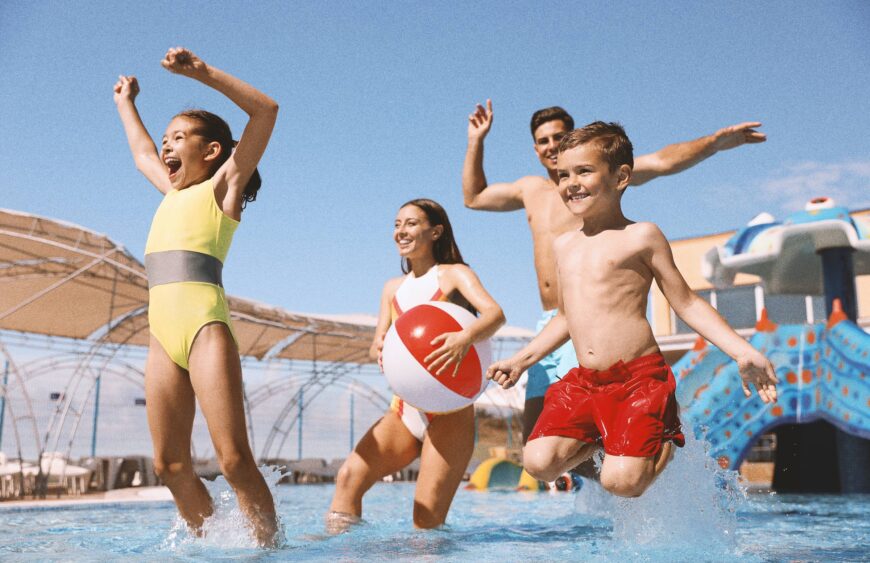
Just because 99% of ships and have lifeguards watching about 99% of all the water in the ship, it doesn’t mean you can let you kids run around unattended. We will tell you right now: Don’t be those parents. Full Stop. What it means in practice is that a parent or responsible adult needs to be actively watching children in the water at all times. Not sitting nearby. Not glancing up from a book. Watching. Drowning is quiet and fast. It doesn’t look the way it looks in films. A child in difficulty can go under without any splashing or calling out. Yes even in a hot tub.
Some ships have dedicated splash areas or shallow wading pools for younger children, and these can be far better suited to toddlers than the main pool. Find out where these are before your kids ask to go swimming. Knowing in advance means you’re not discovering on arrival that the splash zone is on a different deck from where you’ve set up for the day.
Life jackets for children are available onboard as part of the safety equipment at muster stations. Most ships won’t let you use any safety equipment you bring. They prefer you use theirs, mostly for insurance purposes.Knowing where they are and how to fit one on your child correctly is something to cover during your muster orientation, not something to figure out under pressure.
If your child is prone to motion sickness, it’s worth knowing that a child who is unwell is harder to keep track of and less predictable near water. Our guide to dealing with seasickness in children covers what actually works. And for broader water safety guidance beyond the ship, our post on staying safe around water with kids is worth a read before any beach excursion day.
If something goes wrong
No one wants to rehearse emergencies on holiday. But knowing the basics beforehand means you’re making decisions from a position of calm rather than panic.
Know your onboard security contacts from day one. Every ship has a Guest Services desk and a dedicated Security Officer. These are your first points of contact for any safety concern, whether that’s a missing child, a medical situation, or anything that feels wrong. The number for Guest Services is usually on a card in your cabin. Save it in your phone before you leave port.
Understand the ship’s protocol for a missing child. Most major cruise lines operate a formal Code Adam protocol, similar to what you’d see in a shopping centre, where the ship moves into a structured search mode with crew assigned to specific areas. If your child can’t be found, go directly to Guest Services or the nearest crew member and use the words “missing child” clearly. Don’t search independently first. Alert the crew immediately and let the system work.
Travel insurance that covers medical evacuation at sea is not optional. A standard policy may not cover the cost of a helicopter or tender evacuation to a shoreside hospital. This can run to thousands of euros or pounds and isn’t something most families can absorb unexpectedly. Before you travel, check your policy specifically for medical evacuation coverage and for treatment received outside your home country. Our travel insurance guide for families explains what to look for in plain language, and the family travel insurance deep-dive goes further on the specifics worth checking.
It’s also worth carrying a family travel safety sheet with each child’s blood type, allergies, medications, and emergency contacts. The medical centre will ask for this information in a stressful moment. Having it written down rather than trying to remember it under pressure is a small thing that makes a real difference. Our emergency contacts and travel safety sheet template is ready to fill in before you go.
Cruise families who enjoy themselves most aren’t the ones who worry least. They’re the ones who sorted the basics early and then genuinely switched off. That’s what all of this is for. Know your meeting point, watch the water, check your insurance, and go have an excellent holiday.
We use cookies to ensure that we give you the best experience on our website. If you continue to use this site we will assume that you are happy with it.