It’s A Different Kind of Awareness When You’re Far From Home
So, here’s the thing about water and travel. Kids see a pool or a beach and instantly enter holiday mode. Parents follow right behind them, trying to enjoy the moment but also quietly scanning the scene because new places come with new variables. At home you know the usual hazards. Abroad everything looks fresh and exciting, and that excitement makes it surprisingly easy to miss a few details until you’re right there dealing with them.
Staying safe around water with kids abroad isn’t about stress or hyper vigilance. It’s about setting yourself up for relaxed days by taking a moment to understand the space you’re in. You get small clues the moment you arrive, and once you learn to catch them, the whole environment starts to make sense. Children also pay attention to what we notice. When you show them how to approach water confidently, they pick up on that energy.
By the way, this fits in naturally with everything we covered in our Sun Safety for Children on Holiday article (coming soon), because water and sun tend to be part of the same family day. And if you pair this with the advice in our piece about Heat Safety and Hydration for Kids Abroad, you get a little trio of travel habits that keep days outdoors a lot smoother.
What you’ll find in this guide:
When water safety feels different
Poolside realities
Beach days in unfamiliar places
Lakes, rivers, and still water
Hotel water parks and splash zones
Gear that helps
Teaching kids water awareness
When something feels off
FAQ’s
Why Water Safety Feels Different Abroad
When you’re travelling, you don’t have the luxury of familiarity. Pools follow different design traditions, beaches behave differently depending on the coastline, and local safety standards vary widely. Some countries add warning signs everywhere. Others keep things simple and rely on visitors to understand their surroundings without much guidance.
Many parents only realise this once they get to the pool and notice that depth changes happen faster than expected or that tiles feel smoother than what they’re used to back home. Older hotels often keep their original pool layouts, which can mean deeper water right at the edge or steps that blend into the floor a little too well for energetic children.
If you’ve already read our Child Safety in Busy Tourist Areas article, you’ll recognise the same theme here. New environments ask you to look around a little before settling in. A quick walk around the water helps you understand how kids might move in that space. Once you get that sense of the environment, you can relax into the day instead of constantly reacting to surprises.
Poolside Realities Parents Notice Once They Arrive
Pools are often the heart of a family holiday, and each pool has its own personality. Some have shallow slopes that make it easy for kids to ease in. Others jump straight to deeper sections that require you to stay close. Hotels sometimes place loungers right at the water’s edge, which means kids weave through tight spaces on slippery surfaces. The layout gives you a lot of clues about how to move safely.
In many older European pools, for example, the tiles become smooth over time. They look clean and well kept, and they are, but they turn into mini skating rinks for toddlers who run too fast in excitement. Depth markers also vary. Some are painted and easy to spot, while others fade under years of sunlight and become something you need to double check.
If you’ve ever owned a pool you’ll recognise that Pool safety is pretty universal. A thirty second walk around the edge pays off. Doing a mental checklist of possible dangers, and warning signs. You can spot deeper areas, crowded zones, and good entry points way before the kids start running toward the water.
Beach Days in Unfamiliar Places
Beaches days always feel like a dream for kids. Soft sand, new shells, little fish darting near the shore. Parents usually feel that mix of joy and alertness because beaches shift through the day in ways that aren’t always obvious at first glance. The waves might seem gentle in the morning and much stronger by afternoon. The slope under the water can change quickly. And currents can behave differently than the ones kids know at home.
If you’re visiting the Mediterranean, the sea often acts like a giant pool. Clear water, small waves, and long gentle slopes make it feel very approachable. Move to the Atlantic, and the sea often has a more powerful rhythm. Not dangerous by default, just more energetic. A beach can look calm until one stronger wave shows up and catches a child off guard.
These are the kinds of moments when kids benefit from a simple explanation. A quick “let’s watch how the waves move before we go in” helps them understand the pattern and join it rather than fight it. Keeping an eye our for lifeguard stations, (not just to watch lifeguards apply sunscreen) helps. They are your entry to understanding the lay of the land. Sometimes they provide a summary of the dangers. Weather forecasts, and local pests that might sting can also be listed there as well. Observation is your best friend when entering a space you don’t fully know yet. Kids learn from the way you model that curiosity.
Lakes, Rivers, and Still Water
Still water creates a feeling of calm that can be deceptive. Lakes look peaceful because they don’t move like the sea, but the conditions under the surface vary enormously. Some lakes stay warm near the shore and drop to very cold temperatures just a little further in. Kids jump expecting one thing and get something completely different, which can startle them. It’s not dangerous when you’re right there beside them, but it helps to know beforehand.
Rivers bring another layer altogether. Even slow ones can have sections with stronger movement under the surface. Kids love stepping into rivers to feel the flow against their legs, and that is a wonderful experience when done in safe zones. Watching how locals enter the water gives you a sense of which parts of the river are commonly used and which are avoided.
Still water also tends to have low visibility. Parents often prefer lakes for that reason because it looks calm, but the bottom shifts from sand to mud to rocks very quickly. Giving your kids a moment to watch how the ground changes as they step in helps them move more steadily. These are the kinds of little adjustments that make the day feel smooth instead of unpredictable.
Hotel Water Parks and Splash Zones
Nothing gets kids running faster than spotting a hotel water playground. Slides, fountains, tipping buckets, and climbing structures give families hours of entertainment. They also bring crowds and movement in all directions. Kids disappear behind structures, dart out the other side, and follow the flow of the water without checking who is around them.
Different hotels structure their play areas differently. Some manage slide queues carefully, while others let kids go one after another without much spacing. The landing zones at the bottom of slides sometimes vary in depth, and certain areas funnel kids into the same spot more quickly than you expect.
Parents who have read our Walking Tours With Kids article may recognise the trick of getting a feel for a place before diving in. Watching a few minutes of activity tells you exactly how the water park moves. You see where your child will pop out after a slide. You notice which corners get crowded around the same time each day. It’s not intense supervision. It’s simply understanding the layout so the fun stays fun.
Gear That Actually Helps
Travel tends to turn families into minimalists. You carry only what you need and hope it covers most situations. With water, this means choosing gear that supports your kids rather than gear that looks cute in photos.
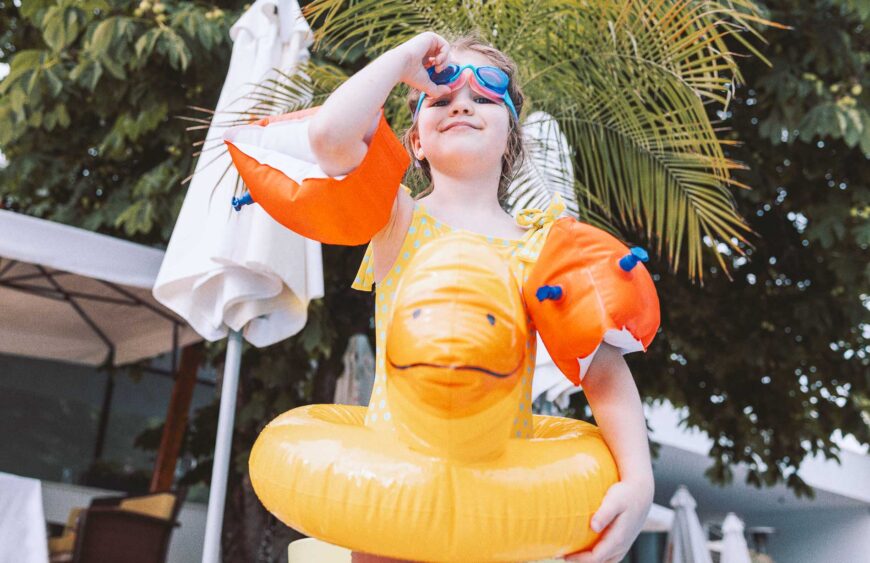
Floaties are enjoyable, and kids often love them, but they don’t help much when a child needs support in the right direction. A proper life vest or swim vest gives kids buoyancy that keeps them upright and stable. If you’re planning boat days, deep water swimming, or exploring lakes, life vests become incredibly useful.
Some hotels offer vests or flotation aids. They might not always fit perfectly, so checking straps and snugness helps you avoid mid swim adjustments. Kids adjust to them quickly once they realise they can move comfortably. Gear shouldn’t replace supervision, but the right piece of equipment can take a little pressure off when your child is still gaining confidence in new water environments.
Teaching Kids Water Awareness While Travelling
Kids thrive when they understand the environment they’re stepping into. Water abroad behaves differently in each place, and giving your child simple cues helps them navigate it confidently. You can narrate what you’re noticing. “This part gets deeper quickly,” or “Let’s stand where we can see the bottom clearly,” or “Let’s watch how the waves move before we join in.” Kids absorb this kind of guidance easily.
Some parents like to give children small jobs such as choosing where to set up on the beach or pointing out depth markers at the pool. This gives kids a sense of involvement. They understand the surroundings as something they participate in, not just something happening around them. It also helps build their awareness of danger and how to operate in a new environment safely. So you don’t always have to feel like a helicopter parents.
This approach lines up with what we covered in Heat Safety and Hydration for Kids Abroad. Kids need simple, clear expectations that adjust depending on where they are. When you explain the boundaries gently, they usually stay within them because they feel included in the decision rather than restricted by it.
When Something Feels Off
Parents notice tiny cues long before kids do. A pool that suddenly feels too crowded. A beach section that doesn’t match the conditions you saw thirty minutes earlier. A slide landing area that’s getting chaotic. None of this requires panic. It simply asks for a small, logical adjustment.
Sometimes taking a break helps everyone reset. Sometimes moving a few meters makes the environment feel different. Sometimes leaving entirely opens up something more enjoyable somewhere else. Travel gives you options, and listening to your instinct usually leads to smoother days.
Children follow your lead. When you shift calmly without making it a big deal, they accept it as part of the adventure rather than a disruption. You’re allowed to change the plan whenever the energy of a place doesn’t sit right with you or your family.
Water Safety Abroad Is About Awareness, Not Worry
So here’s the real heart of it. Staying safe around water with kids abroad doesn’t require perfection. It requires presence. A moment of observation. A bit of curiosity. When you understand how the water behaves in a new environment, you relax. Your kids relax with you. And suddenly the holiday becomes what you hoped for when you booked it.
Water is one of the best parts of travel for kids. It brings joy, novelty, and unforgettable memories. A little awareness makes sure those memories stay positive.
Too Long? Here are the most common questions we’re asked.
Design standards, lifeguard presence, and natural conditions vary widely. Observing how families and locals use the space gives you instant context.
Watch the waves for a moment, look for flags or signs, and note where locals swim. Small clues tell you whether the water is calm or more energetic.
Not always. Lakes can have slippery edges, cold shock, and sudden depth changes. A quick scan helps you set safe expectations.
If they’re near deep water, waves, or boats, a vest adds real support. Floaties alone don’t offer the same stability.
Change spots, take a breather, or leave. Your comfort matters as much as your child’s. Trusting your instinct usually leads to better experiences.